On this page
Top picks at a glance
As an Amazon Associate I earn from qualifying purchases.
- 1
 Atwater HydroPod Dual DWC and Recirculating Drip Garden System9.6/10View on Amazon
- 2
 VIVOSUN FlexFeed DWC Hydroponic System Kit9.6/10View on Amazon
- 3
 VIVOSUN VGrow DWC Hydroponics System Kit for VGrow Smart Grow9.6/10View on Amazon
- 4
 Psycloner Clone MachineView on Amazon
- 5
 EC pH Continuous Monitor for HydroponicsView on Amazon
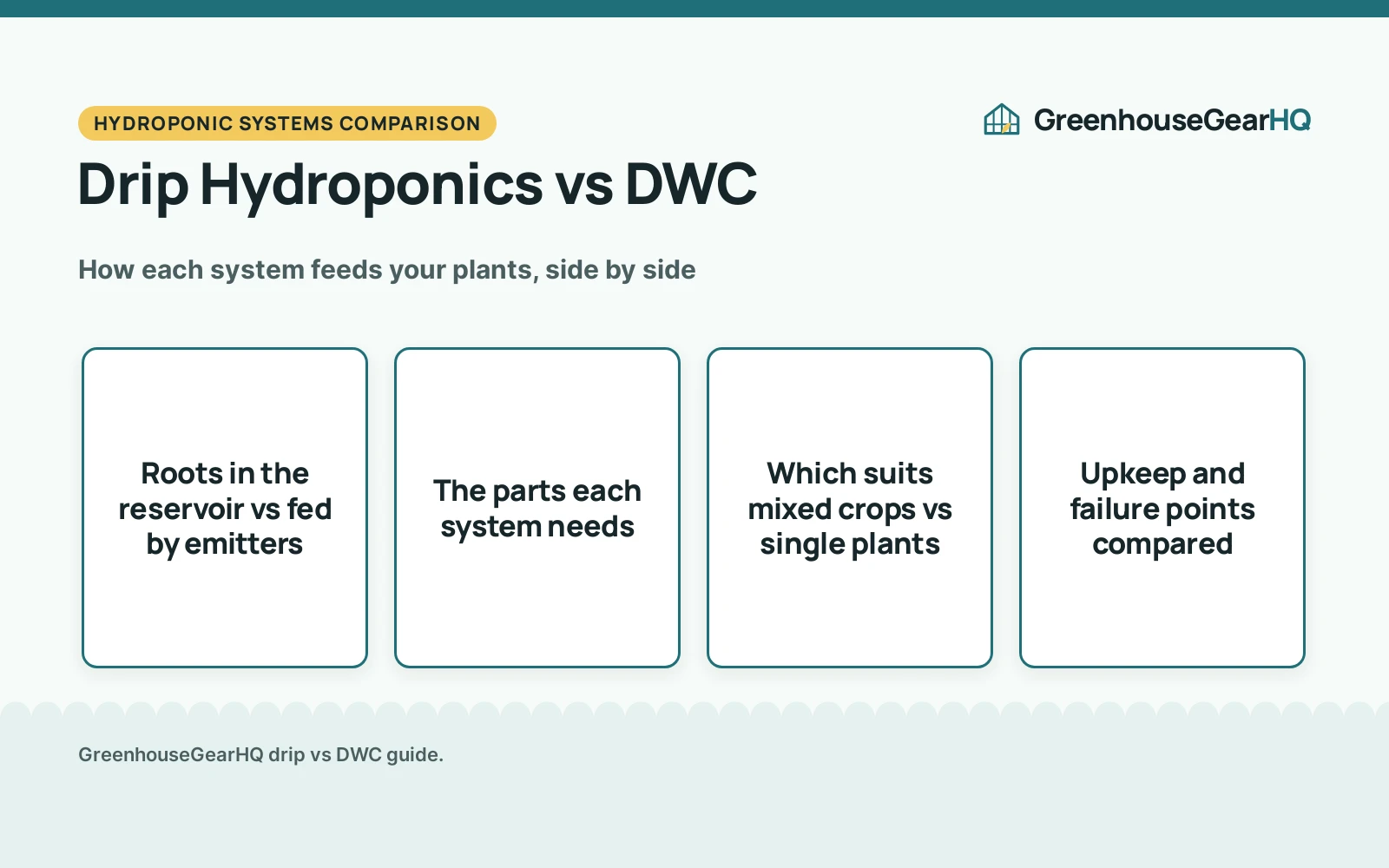
Drip hydroponics vs DWC comes down to one question: how do the roots meet the nutrient solution? In a drip system, a pump pushes solution through tubing and emitters to the root zone of each plant, on a timer or as a slow continuous feed. In DWC, short for deep water culture, each plant’s roots hang straight down into a bucket or tub of aerated nutrient solution. Both methods grow plants without soil, and the right one depends on how many plants you run, how different they are, and how much daily attention you want to give.
Other options worth a look
 Psycloner Clone MachineCheck price on Amazon
 EC pH Continuous Monitor for HydroponicsCheck price on Amazon
GreenhouseGearHQ earns a commission when you buy through links on this page, at no extra cost to you. As an Amazon Associate I earn from qualifying purchases. Affiliate disclosure.
The short answer: drip hydroponics vs DWC
Choose drip hydroponics when you grow several plants that want different amounts of water or food, because each emitter, valve and line can be adjusted per plant. Choose DWC when you want a simple, self-contained setup per plant, because each bucket is its own reservoir and needs only an air pump and air stone to keep the solution aerated. If you like the sound of both, some kits combine them: the VIVOSUN DWC system lists 2 5-gallon buckets with a top drip kit, so each plant gets a drip ring above and a deep reservoir below.
How a drip system feeds your plants
A drip setup starts with a reservoir and a pump, then tubing carries the solution to each plant. The SUCOHANS micro sprayer set lists 90 pieces, 30 each in 90, 180 and 360 degree patterns, with a 31.4 GPH flow rate at 20 PSI, and screws into 1/4 inch ID tubing with a 10-32 thread. Small parts add up fast: the CESTAME fitting kit lists 280 pieces total, including 100 straight barbs, 30 single barbs, 75 tees, 25 elbows, 25 end plugs and 25 four-way couplings, all sized for 1/4 inch tubing. For control at the line level, the Habitech 2-pack lists in-line ball valves for 3/4 inch tubing, watertight up to 45 PSI and rated to a 100 degree F maximum.
Tubing choice matters too. The Hydrofarm Active Aqua listing gives a 25 foot roll of 3/4 inch ID vinyl tubing with a 0.19 inch wall thickness and a 25 psi maximum pressure, made to be cut to length for drip and hydroponic systems. The simplest drip of all is a wick: the ORIMERC listings give a 30 foot length at 1/5 inch diameter and a 150 foot length at 1/4 inch diameter, and state that a soaked wick drips within 15 minutes, which suits a small pot left alone for a few days. A Hydro Halo ring from Bloom Brothers, 6 inches across with a 3 leg support, spreads water evenly around one plant’s root zone.
How a DWC system feeds your plants
DWC skips the emitters. Each plant sits in a net pot or basket with its roots in the nutrient solution, and an air pump plus air stones keeps that solution full of oxygen. The VIVOSUN listing describes the parts clearly: 2 five-gallon buckets, 2 eight-inch baskets, an 8W air pump with an adjustable 4×4 L/min output, 6 meters of air hose, 4 air stones, 2 water level tubes, 2 drip irrigation rings and 2 clay pebble packs. Because the roots live in the reservoir, the whole system is just bucket, basket, air and nutrients.
Feeding is straightforward in either system. The General Hydroponics CALiMAGic listing, a 1 quart bottle, gives a 1-0-0 NPK in its bullets and a 1:1000 mixing ratio, and states it will not clog spray lines or drip emitters. Note the same listing’s spec table prints 5-0-1 instead; the bullets carry more weight, so use the 1-0-0 figure. For overflow and leaks, the Living Whole Foods 5 pack lists trays at 21 by 11 by 2 inches with no drain holes, handy as drip trays under pots or buckets.
Drip vs DWC at a glance
| Feature | Drip hydroponics | DWC |
|---|---|---|
| Where the roots sit | In pots, trays or grow media, fed from above | Hanging in the nutrient reservoir itself |
| How nutrients arrive | A pump pushes solution through tubing, valves and emitters to each plant | Roots draw from the reservoir while an air pump bubbles air through it |
| Parts involved | Pump, reservoir, tubing, emitters, fittings, valves | Bucket, basket, air pump, air stones, reservoir |
| Tuning per plant | Easy: adjust or shut off individual emitters and valves | Harder: all plants in one bucket share the same solution |
| Common failure point | A clogged emitter starves one plant, so check flow at each emitter | If the air pump stops, the reservoir loses aeration |
Choosing between drip and DWC
When drip wins
Drip wins when your plants are not all the same. Tomatoes, peppers and herbs in separate pots can each get their own emitter or valve setting, and the CESTAME 280-piece fitting kit shows how granular a drip layout can get. Drip also suits long rows and beds, where one pump and a run of 25 foot tubing can serve plant after plant. See our drip emitters vs micro sprayers comparison for the delivery end of the system.
When DWC wins
DWC wins on simplicity. One bucket, one basket, one air pump and the plant is growing. Leafy greens and herbs do well with their roots constantly in aerated solution, and the VIVOSUN kit’s parts list shows how little you need: buckets, baskets, air pump, air stones, hose and nutrients. There are no emitters to clog and no lines to balance, which makes a first hydroponic try less fiddly. Our DWC vs NFT hydroponics guide compares DWC with another water-based method.
Mixing crops and mixing methods
You do not have to pick one method for everything. Many growers run DWC buckets for greens and a drip line for larger fruiting plants on the same shelf, since the two systems share only the nutrient mixing habit, not the plumbing. The VIVOSUN system’s top drip kit is built on that idea, pairing a drip ring with a deep water bucket in one unit. If budget sets the ceiling, our best hydroponic system roundup compares complete kits by their stated parts.
FAQ for growers
Can I run drip and DWC together?
Yes. The VIVOSUN kit lists 2 five-gallon DWC buckets each with a drip irrigation ring, so the top of the root zone gets drip feed while the roots grow down into the aerated reservoir.
Which system needs more parts?
Drip needs more small parts: pump, tubing, emitters, fittings and valves, with fitting kits like the 280-piece CESTAME set showing the count. DWC needs fewer: a bucket, a basket, an air pump and air stones, as the VIVOSUN parts list shows.
How do I keep drip emitters from clogging?
Use nutrients that state they suit drip lines. The CALiMAGic listing states it will not clog spray lines or drip emitters, and it mixes at 1:1000. Check flow at each emitter when you mix a fresh reservoir, and replace a sprayer that runs weak rather than clearing it by force.
Do DWC roots need light protection?
Keep light out of the reservoir, since algae grows where light meets nutrients. Opaque buckets and lids that fit the baskets, like the 5-gallon buckets and 8-inch baskets in the VIVOSUN kit, do that job.
Keep reading
See every Hydroponic Systems guide and all Indoor Growing guides. Also see our DWC vs NFT Hydroponics. Also see our Hydroponic Tower vs DWC. Also see our Drip Emitters vs Micro Sprayers.
More picks: hydroponic systems, gravity vs pump drip, drip tape vs tubing and indoor drip systems.