On this page
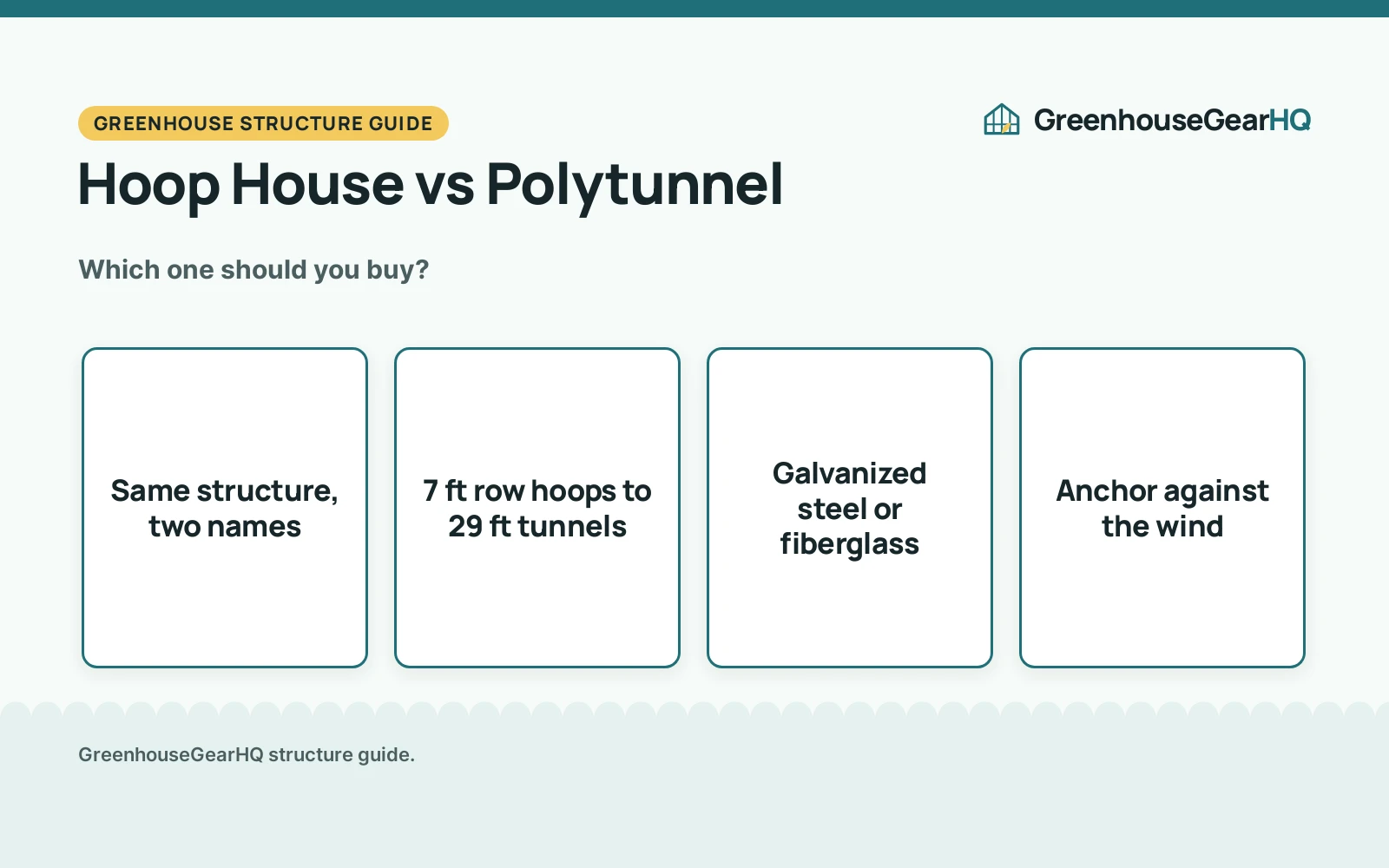
The hoop house vs polytunnel question has a short answer: they are the same structure under two names: a row of hoops covered in plastic film. “Polytunnel” is the common term in the UK, “hoop house” in the US, and listings use them interchangeably: the VEVOR walk-in tunnels call themselves hoop houses in the same title. The real choice is not the name but the size, the frame and the cover. This guide explains what the terms mean, how to size one, and what to check before buying. Where a number appears, it comes from a product listing we compared.
GreenhouseGearHQ earns a commission when you buy through links on this page, at no extra cost to you. As an Amazon Associate I earn from qualifying purchases. Affiliate disclosure.
Hoop house vs polytunnel: which one should you buy?
Buy the structure that fits the job, and ignore the label. For protecting a single raised bed, a set of 7 ft garden hoops is enough. For walking inside and working standing up, buy a walk-in tunnel: the listings run from 15 by 7 by 7 ft up to 29.2 by 9.7 by 6.5 ft. Galvanized steel frames suit larger and windier sites; fiberglass hoops suit small beds. Whichever name the listing uses, check the dimensions, the frame material and the cover before anything else.
What the two names actually mean
Both names describe one idea: hoops stuck in the ground or fixed to a base rail, skinned with polyethylene film. In the UK the trade says polytunnel; in the US it says hoop house or high tunnel. A “high tunnel” sometimes means a taller, more permanent version, but a hoop house and a polytunnel are the same thing. When a listing says “walk-in tunnel greenhouse” and “hoop house” in one title, as the VEVOR listings do, take the hint: the words are marketing, the measurements are the product.
Size: from row hoops to walk-in tunnels
Hoop structures come in two families. Row hoops cover a single bed: the Xuwzenkl sets offer 7 ft fiberglass hoops in sets of 12 (60 pieces) or 6 (30 pieces), and the Gardener’s Supply set holds 6 super hoops. These are for frost cloth and row cover over crops, not for people.
Walk-in tunnels are buildings you enter. The Outsunny listings give 15 by 7 by 7 ft at 33 lbs and 20 by 10 by 7 ft at 67 lbs; the VEVOR listings give 19.4 by 9.7 by 6.5 ft at 70.6 lbs and 29.2 by 9.7 by 6.5 ft at 88.2 lbs. Height matters as much as footprint: 6.5 to 7 ft lets most people work upright. Measure the bed or the plot first, then pick the tunnel that covers it with room to walk.
Frames and covers
Frames in the listings are galvanized steel on the walk-in tunnels and rust-proof fiberglass on the row hoops. Steel carries the larger spans; the 29.2 ft VEVOR tunnel needs its steel frame to hold shape. Fiberglass is lighter and fine for 7 ft bed hoops. Covers are PE film, green on one VEVOR model and white on the other; white reflects more light and stays cooler, green blends into the garden. The Outsunny 15 by 7 model states a 1-year warranty against manufacturer defects, the only warranty figure in the listings.
Ventilation and access
A sealed tunnel overheats fast on a sunny day, so doors and windows are working parts, not extras. The Outsunny 20 by 10 ft model lists 8 mesh windows and a zippered door; the 15 by 7 ft model lists 6 roll-up windows and a roll-up door; both VEVOR tunnels list 12 windows with roll-up zipper doors. Roll-up sides and doors let you tune airflow through the day. When comparing two tunnels of similar size, the one with more vent openings wins for summer growing.
Anchoring and weather
Film-covered tunnels catch wind like sails. The VEVOR listings include a stakes kit, and the Outsunny listing describes anchoring the frame into the soil to stay open and upright. Whatever you buy, anchor every hoop: stakes, ground posts or base rails, plus ropes over the top in exposed sites. A tunnel that survives its first storm is a tunnel that was anchored on day one, not after.
In the Greenhouse
- Call it either name when shopping; compare dimensions, frame and cover instead.
- Pick row hoops for beds and walk-in tunnels for standing work.
- Count the windows: more vent openings mean better summer control.
- Anchor every hoop on day one; film tunnels catch wind.
FAQ for growers
Is a hoop house the same as a polytunnel?
Yes. Both are hoops covered in plastic film; “polytunnel” is the UK term and “hoop house” the US term, and listings use both for the same product.
What size hoop house do I need?
For a single bed, 7 ft row hoops. For walking inside, the listings run 15 by 7 by 7 ft to 29.2 by 9.7 by 6.5 ft; pick the footprint that covers the plot with room to work.
How do you ventilate a polytunnel?
Through doors and windows: the listed tunnels have 6 to 12 windows plus roll-up or zippered doors. Open them on sunny days and close before cold nights.
Keep reading
Also see our hoop house vs high tunnel. Also see our polytunnel vs polycarbonate greenhouse. Also see our PVC vs steel hoop house.
More picks: pop up greenhouse vs hoop house, hoop house for winter, hoop house for raised bed and walk in greenhouse for tomatoes.