On this page
Top picks at a glance
As an Amazon Associate I earn from qualifying purchases.
- 1
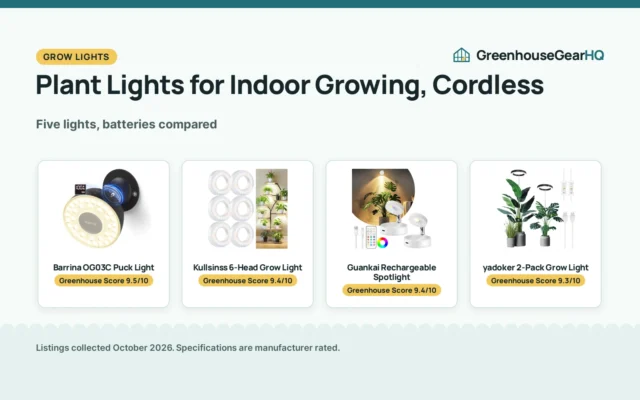
 Barrina OG03C Rechargeable Puck Grow Light9.5/10View on Amazon
- 2
 Kullsinss 36W 6-Head Full Spectrum Grow Light with Timer9.4/10View on Amazon
- 3
 Guankai 2 Pack Rechargeable LED Spotlight Grow Light9.4/10View on Amazon
- 4
 GooingTop Grow LightView on Amazon
- 5
 EZVALO Spot Lights IndoorView on Amazon
- 6
 LED Plant Grow LightView on Amazon
- 7
 2 Head LED Plant Grow LightView on Amazon
- 8
 LORDEM Bamboo Grow Light for Indoor PlantsView on Amazon
- 9
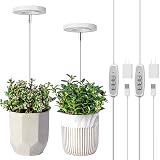 LORDEM Grow Light for Indoor PlantsView on Amazon
Houseplants by a dim window can look full in summer and tired by midwinter, when short days and weak sun leave leaves pale and stems leaning toward the glass. The question behind that lean is how much light do indoor plants need: most houseplants grow best in bright light that never strikes the leaves directly, while a smaller group tolerates shade and a few others ask for a sunny sill. This guide explains how to read the light in a room and when a grow light helps.
Other options worth a look
 GooingTop Grow LightCheck price on Amazon
 EZVALO Spot Lights IndoorCheck price on Amazon
 LED Plant Grow LightCheck price on Amazon
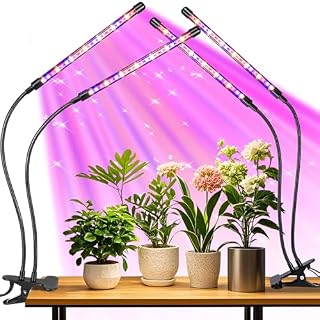 2 Head LED Plant Grow LightCheck price on Amazon
 LORDEM Bamboo Grow Light for Indoor PlantsCheck price on Amazon
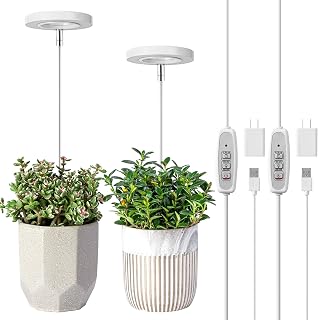 LORDEM Grow Light for Indoor PlantsCheck price on Amazon
GreenhouseGearHQ earns a commission when you buy through links on this page, at no extra cost to you. As an Amazon Associate I earn from qualifying purchases. Affiliate disclosure.
How much light do indoor plants need?
Light for indoor plants falls into broad bands, and the band a plant wants decides where it sits. Bright indirect light means a spot near a window where the sun never falls straight on the leaves. Medium light means a spot a few steps back from that window. Low light means a corner that stays shaded through the day. Direct sun means rays landing on the leaves for part of the day, which suits sun-loving plants and scorches the rest.
The plant label gives the band for each plant, and the room gives the rest of the answer. A window throws a different patch of sun in winter than in summer, so move plants when the patch moves. Leaves tell the story too: pale leaves and thin stems reaching for the window point to too little light, while bleached patches point to too much direct sun.
When the room cannot give a plant its band, a grow light fills the gap. The reference listings compared for this guide show the stated figures: a floor lamp at 48W with a timer, a 100W panel covering 2×2 ft, a panel listed at 120W with 100W standard power, and a 320W bar covering 2×4 ft or 3×5 ft.
How to give indoor plants the light they need, step by step
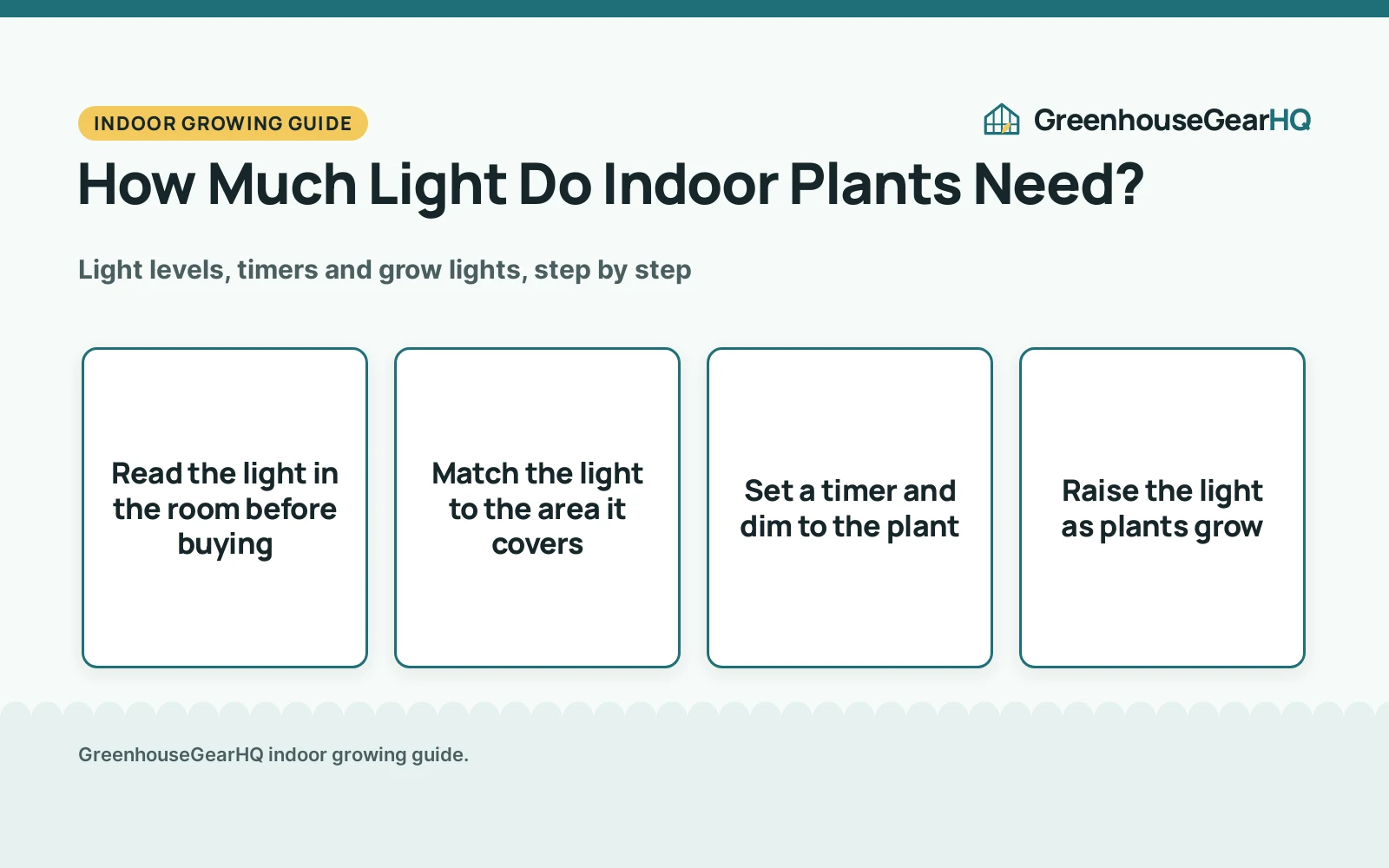
Step 1: Read the light in the room
Stand where the plant will sit and watch the window through the day. Note which hours the sun reaches the spot and whether a tree or a tall fence outside shades it. A bright room with no direct sun suits most houseplants, while a sunny sill suits the small group that asks for direct rays. Move the plant, not the window: a shelf near the sunniest window beats a dark corner with a lamp.
Step 2: Match a grow light to the space
Match the light to the area it must cover. The Spider Farmer G4500 (on Amazon) lists 320W with coverage of 2×4 ft or 3×5 ft, which suits a wide shelf or a tent. The VIVOSUN AeroLight A100 (on Amazon) lists 100W and coverage of 2×2 ft or 2×4 ft, and the HHNMAHN panel lists 100W standard power, 120W maximum and coverage of 2×2 ft. The GLOWRIUM floor lamp (on Amazon) lists 48W with dual heads on a pole that adjusts from 23 to 79 inches, which suits a tall plant.
| Reference listing | Stated power | Stated coverage | Stated controls |
|---|---|---|---|
| GLOWRIUM dual-head floor lamp | 48W | Not stated | 3 lighting modes, 3/9/12/16H timer |
| Spider Farmer G4500 | 320W | 2×4 ft or 3×5 ft | 10-100% dimming, daisy chain up to 50 lights |
| VIVOSUN AeroLight A100 | 100W | 2×2 ft or 2×4 ft | App control, built-in circulation fan |
| HHNMAHN GL1 panel | 100W standard, 120W maximum | 2×2 ft | 0-100% dimming |
Shape matters as much as power. Long bars suit long shelves, square panels suit a deep shelf or a tent, and a floor lamp with a flexible gooseneck suits a tall plant that a hanging panel cannot reach. The GLOWRIUM listing states a 360° gooseneck, and the VIVOSUN and HHNMAHN listings state hanging hooks. See the grow lights for indoor plants roundup for more bars and panels.
Step 3: Set the timer and brightness
A timer keeps the light steady when nobody is home to switch it. The GLOWRIUM listing offers timer settings of 3, 9, 12 and 16 hours, and the Spider Farmer and VIVOSUN listings offer app control with custom schedules. Dimming sets the brightness to the plant: the Spider Farmer G4500 lists 10-100% dimming and the HHNMAHN panel lists 0-100% dimming, while the GLOWRIUM listing lists 3 lighting modes with stepless dimming. Follow the plant label and the light maker’s manual for the setting, since the right figure differs by plant and by light. See how to set a timer for lights for the setup in detail.
Step 4: Hang or stand the light at the right height
Height sets how much light reaches the leaves. The GLOWRIUM pole adjusts from 23 to 79 inches, so the heads can rise as a tall plant grows. Hanging panels hang from the shelf above or a tent frame: the VIVOSUN listing states hanging hooks and a magnetic plate, and the HHNMAHN listing states hanging hooks with an adjustable lanyard. Raise the light as the plant grows, and follow the hanging distance in the light maker’s manual.
Step 5: Watch the plant and adjust
Give a new setup time, then read the leaves. Pale leaves and stems leaning toward the window point to too little light, so lower the light or raise the brightness a notch. Brown or bleached patches point to too much direct light, so raise the light or move the plant back. New growth that holds its colour and shape means the setting suits the plant.
Window light or a grow light?
A window gives free light that shifts with the season, while a grow light gives steady light. Full-spectrum listings mimic daylight: the VIVOSUN AeroLight A100 lists 390nm to 730nm at 3000K and 5000K, and the Spider Farmer G4500 lists 3200K to 4200K, 4800K to 5000K and 650nm to 665nm. The HHNMAHN listing states an IP65 waterproof rating with a working range of -40℃ to 80℃, which suits a damp room or a tent, and the GLOWRIUM listing states a 24V low-voltage system. Warranty terms run from a 2-year term on the GLOWRIUM and HHNMAHN listings to a 3-year term on the VIVOSUN listing and a 5-year term on the Spider Farmer listing.
What this guide does not cover
This guide gives no hour figures or hanging heights for a named plant, because they depend on the plant, the light and the room. The plant label and the light maker’s manual give those figures, and a local extension office can advise on timing. This guide also does not cover fertilizer or pest products; follow the product label.
FAQ for growers
How many hours of light do indoor plants need each day?
Follow the plant label and the light maker’s manual, since the right figure differs by plant. The GLOWRIUM listing offers timer settings of 3, 9, 12 and 16 hours, and a timer switches the light off when the set hours run out.
Can a grow light replace window light?
For many houseplants, yes. Full-spectrum listings mimic daylight: the VIVOSUN AeroLight A100 lists 390nm to 730nm at 3000K and 5000K, and the Spider Farmer G4500 lists 3200K to 4200K, 4800K to 5000K and 650nm to 665nm. Place the light where the plant would sit by a bright window.
How far above the plant should a grow light sit?
Follow the hanging distance in the light maker’s manual, since it differs by light. The GLOWRIUM pole adjusts from 23 to 79 inches, and the VIVOSUN and HHNMAHN listings state hanging hooks, so the height can change as the plant grows.
Do indoor plants need darkness at night?
Plants rest in the dark, so give them a dark stretch each night. A timer handles it: set the hours the plant needs and let the light switch off on its own, as the GLOWRIUM timer settings of 3, 9, 12 and 16 hours allow.
Keep reading
Also see the best indoor grow light roundup, the best light meter for indoor plants roundup, the how to set a timer for lights guide, the best LED grow light bulbs for indoor plants roundup and the how much light a greenhouse needs guide.
More picks: grow lights for indoor plants, indoor grow light, light meter for indoor plants and LED grow light bulbs for indoor plants.