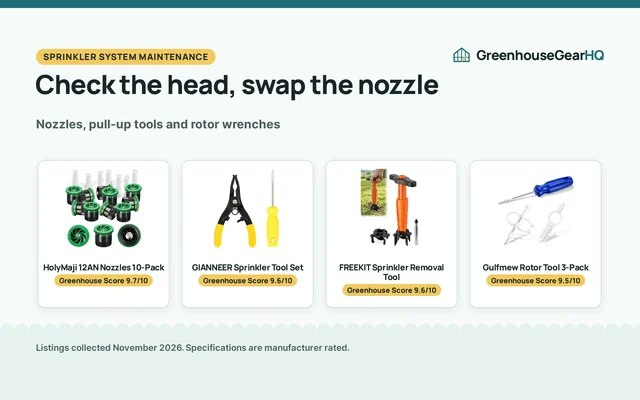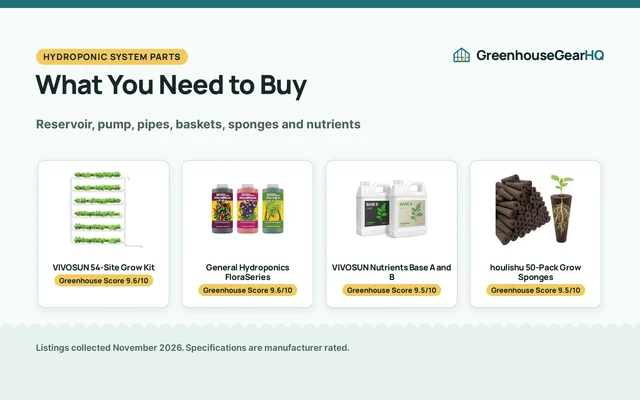
On this page
Top picks at a glance
As an Amazon Associate I earn from qualifying purchases.
- 1
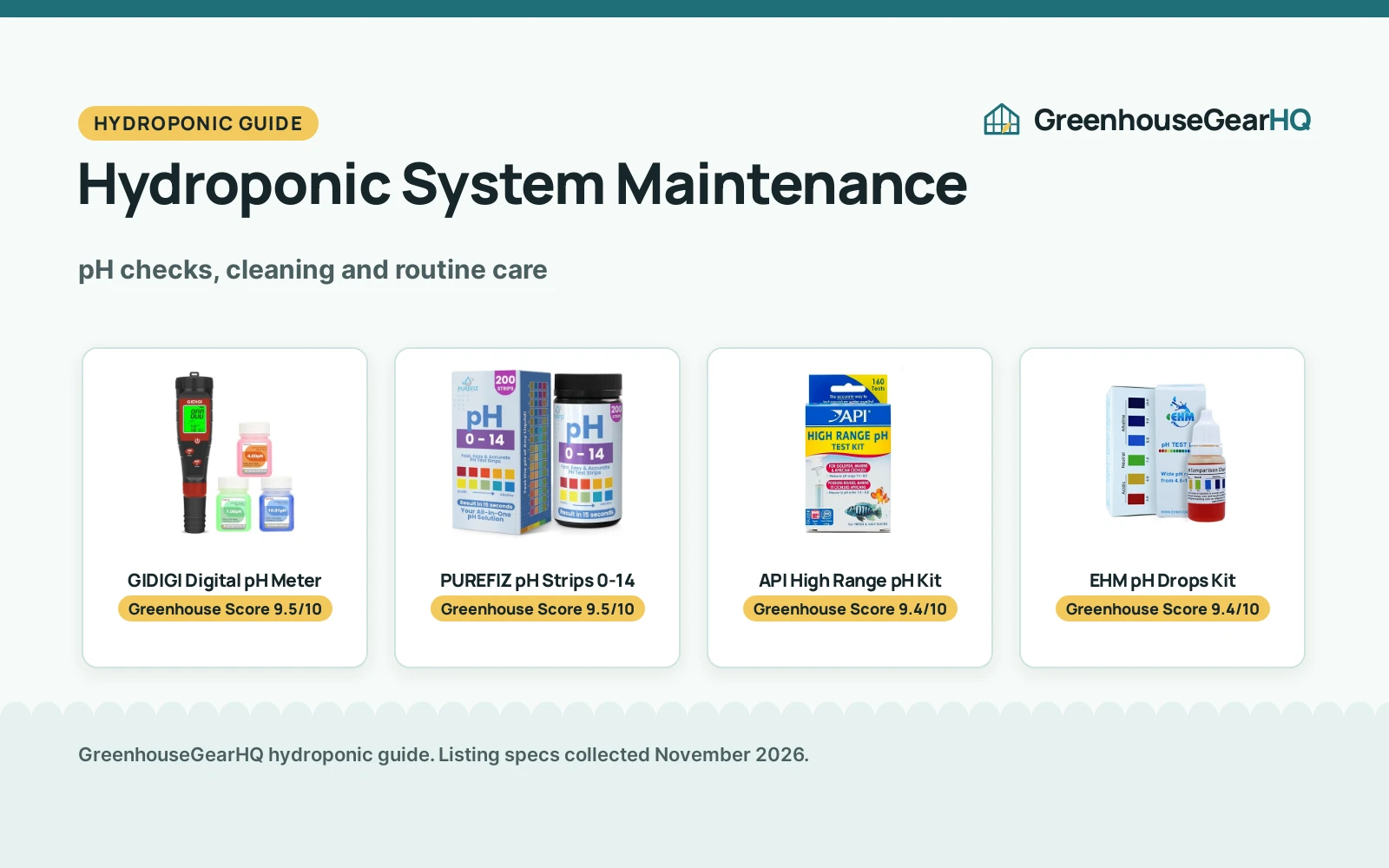
 GIDIGI Digital pH Meter9.5/10View on Amazon
- 2
 PUREFIZ pH Strips 0-149.5/10View on Amazon
- 3
 API High Range pH Kit9.4/10View on Amazon
- 4
 EHM pH Drops Kit9.4/10View on Amazon
Hydroponic system maintenance starts the week the seed trays go under lights, when the nutrient solution is fresh and the pH still holds where the grower set it. This guide covers hydroponic system maintenance step by step: checking pH and nutrient strength, cleaning the reservoir and lines, and watching temperature and airflow. Every figure below comes from a pH tool listing we compared, and each tool is named so the reader can check it.
GreenhouseGearHQ earns a commission when you buy through links on this page, at no extra cost to you. As an Amazon Associate I earn from qualifying purchases. Affiliate disclosure.
| # | Product | Greenhouse Score | Buy |
|---|---|---|---|
| 1 | GIDIGI Digital pH Meter | 9.5/10 | Buy on Amazon |
| 2 | PUREFIZ pH Strips 0-14 | 9.5/10 | Buy on Amazon |
| 3 | API High Range pH Kit | 9.4/10 | Buy on Amazon |
| 4 | EHM pH Drops Kit | 9.4/10 | Buy on Amazon |

GIDIGI Digital pH Meter
A 4-in-1 digital meter that reads pH, TDS, EC and temperature together on one screen for hydroponic nutrient solution.
Pros
- Reads pH, TDS, EC and temperature on one screen at the same time
- Wide pH range of 0.1 to 14.0 with a resolution of 0.1
- Automatic temperature compensation from 0 to 50 C
Cons
- No warranty term is stated
- The sponge cap must stay moist to keep the electrode in good shape
- No battery type or life is stated in the listing

PUREFIZ pH Strips 0-14
A pack of 200 pH strips with a 4-color indicator for quick pH checks of water, hydroponics and more.
Pros
- 200 strips in the pack for regular checks
- 4-color indicator system with a color chart included
- Sealed, moisture-resistant container for storage
Cons
- No warranty term is stated
- Readings come from matching colors on the chart, not a digital display
- No resolution figure is stated in the listing

API High Range pH Kit
A liquid pH kit with 160 readings that reads pH from 7.4 to 8.8 for freshwater and saltwater aquariums.
Pros
- 160 readings in the kit for weekly checks
- Reads pH from 7.4 to 8.8 with a color card included
- Made for freshwater and saltwater use
Cons
- No warranty term is stated
- Aimed at aquariums and fish, with no mention of hydroponics or plants in the listing
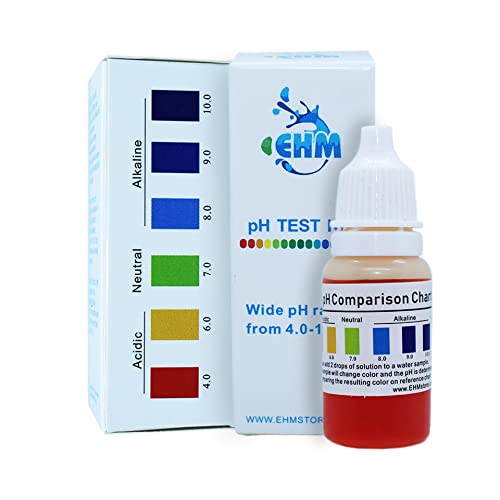
EHM pH Drops Kit
A squeeze-bottle pH drops kit that reads pH from 4.0 to 10.0 in any clear liquid.
Pros
- Reads pH from 4.0 to 10.0 in any clear liquid
- Squeeze bottle with instructions included
- All parts and ingredients made in USA
Cons
- No warranty term is stated
- Only 0.33 Fl Oz in the pack
- No color card is mentioned in the listing
As an Amazon Associate I earn from qualifying purchases.
What hydroponic system maintenance needs
Every running hydroponic system needs the same routine: a pH check, a nutrient strength check, a clean reservoir, and a look at temperature and airflow. Do them in that order, because a pH reading means little if the reservoir has not been cleaned, and a nutrient reading means little if the water has gone warm.
- pH check: a meter, strips or drops that read the nutrient solution. See our pH meter for greenhouse picks.
- Nutrient strength: a meter that reads TDS and EC as well as pH. See our pH meter vs TDS meter comparison.
- Clean reservoir: fresh solution, clean walls and clear lines.
- Temperature and airflow: a meter that reads water temperature, and air moving through the growing space.
How to keep a hydroponic system running, step by step
Check pH and nutrient strength
Check pH and nutrient strength together, because a pH reading on its own says nothing about how much nutrient the water holds. The GIDIGI digital meter (on Amazon) reads pH, TDS, EC and temperature on one screen at the same time, with a pH range of 0.1 to 14.0, EC from 0 to 9990 μS/cm and 10.01 to 19.99 mS/cm, and TDS from 0 to 9990 ppm. The PUREFIZ strips (on Amazon) read pH from 0 to 14 with a 4-color indicator and a color chart. The EHM drops (on Amazon) read pH from 4.0 to 10.0 in any clear liquid, and the API kit reads pH from 7.4 to 8.8 with a color card, though its listing aims at aquariums and fish, not plants.
| Tool | pH range | Form | Best fit | Amazon |
|---|---|---|---|---|
| GIDIGI Digital pH Meter | 0.1 to 14.0 | Digital meter, 4-in-1 | pH, TDS, EC and temperature together | View on Amazon |
| PUREFIZ pH Strips 0-14 | 0 to 14 | 200 strips | Quick color checks | View on Amazon |
| EHM pH Drops Kit | 4.0 to 10.0 | Squeeze-bottle drops | Any clear liquid | View on Amazon |
| API High Range pH Kit | 7.4 to 8.8 | Liquid kit with color card | Freshwater and saltwater aquariums | View on Amazon |
Pick the tool that matches the reading you need. A digital meter suits a grower who checks pH, TDS and EC every round, while strips suit a quick color check before a water change. Drops suit a grower who wants a liquid kit without a meter, and the API kit suits an aquarium keeper rather than a hydroponic grower.
Clean the reservoir and lines
Empty the reservoir, wipe the walls, and rinse the lines when the solution starts to look or smell off. Strips and drops need no cleaning of their own, but keep the PUREFIZ strips in their sealed, moisture-resistant container so they stay dry between checks. Keep the GIDIGI probe moist with its sponge cap, which the listing says extends the life of the probe. Do not add fertilizer or pH adjusters by guesswork: follow the nutrient label and the local extension office for amounts and mixing.
Watch temperature and airflow
Warm water holds less air, so watch the water temperature as part of the routine. The GIDIGI meter reads temperature from 32.0 to 140.0 degrees F and 0.0 to 60.0 degrees C, with automatic temperature compensation from 0 to 50 C. A fan that moves air through the growing space keeps leaves dry and the canopy even, and a shaded reservoir stays cooler than one in direct sun.
The gear for hydroponic system maintenance
The tools below cover the pH and nutrient checks in the routine above: a digital meter that reads pH, TDS, EC and temperature together, strips and drops for quick color checks, and a liquid kit made for aquarium water.
Indoors or inside the greenhouse?
Check each tool’s storage needs before it lives beside a reservoir. The PUREFIZ strips ship in a sealed, moisture-resistant container, which suits a damp growing space. The GIDIGI meter has a sponge cap that keeps the electrode moist, so store it cap on and upright. The API kit is a liquid kit with a bottle, a color card and a tube with a cap, so keep the bottle upright and the cap on. If you are choosing a system to go with these tools, our best hydroponic system picks compare systems for herbs.
What this guide does not cover
We do not give pH targets, nutrient amounts or light hours, because they depend on the crop, the nutrient label and the room. Your nutrient label and the meter manuals give those figures, and your local extension office can advise on timing for your area. We also do not cover pest products; follow the product label.
FAQ for growers
How often should I check pH in a hydroponic system?
Check pH on a weekly routine, as the API kit listing directs for weekly monitoring, and check again when the water or plants look off. A meter that reads pH, TDS and EC together, like the GIDIGI, lets one check cover the nutrient strength too.
What pH range should a hydroponic meter read?
A meter that reads from 0.1 to 14.0 covers every range the tools in this guide list. The PUREFIZ strips read 0 to 14, the EHM drops read 4.0 to 10.0, and the API kit reads 7.4 to 8.8, so a wide-range meter leaves no reading uncovered.
Are pH strips enough for hydroponics?
Strips read pH by color match against a chart, which suits a quick check. For pH, TDS, EC and temperature in one reading, a digital meter like the GIDIGI reads them together on one screen.
Do pH meters and strips need a warranty?
None of the tools in this guide states a warranty term, so compare the stated ranges and features instead. The GIDIGI meter lists a sponge cap that keeps the electrode moist, and the PUREFIZ strips list a sealed container, which are the care features to weigh.
Keep reading
See every hydroponic system guide and all indoor growing guides.
More picks: hydroponic systems, pH meters for water, hydroponic systems for mint and hydroponics vs soil gardening.