On this page
Top picks at a glance
As an Amazon Associate I earn from qualifying purchases.
- 1
 Amazon Basics Ceramic Portable Mini Space Heater Black9.6/10View on Amazon
- 2
 BioGreen Electric Greenhouse Heater and Fan with Digital9.7/10View on Amazon
- 3
 Lerat 500W Portable Mini Space Heater with Overheat and9.6/10View on Amazon
- 4
 Manastin 12000BTU Mini Split AC & Heating SystemView on Amazon
- 5
 12000BTU Mini Split Air Conditioner& HeaterView on Amazon
- 6
 ROVSUN 11500 BTU Mini Split AC/Heating SystemView on Amazon
- 7
 Garvee Mini Split AC with Heat PumpView on Amazon
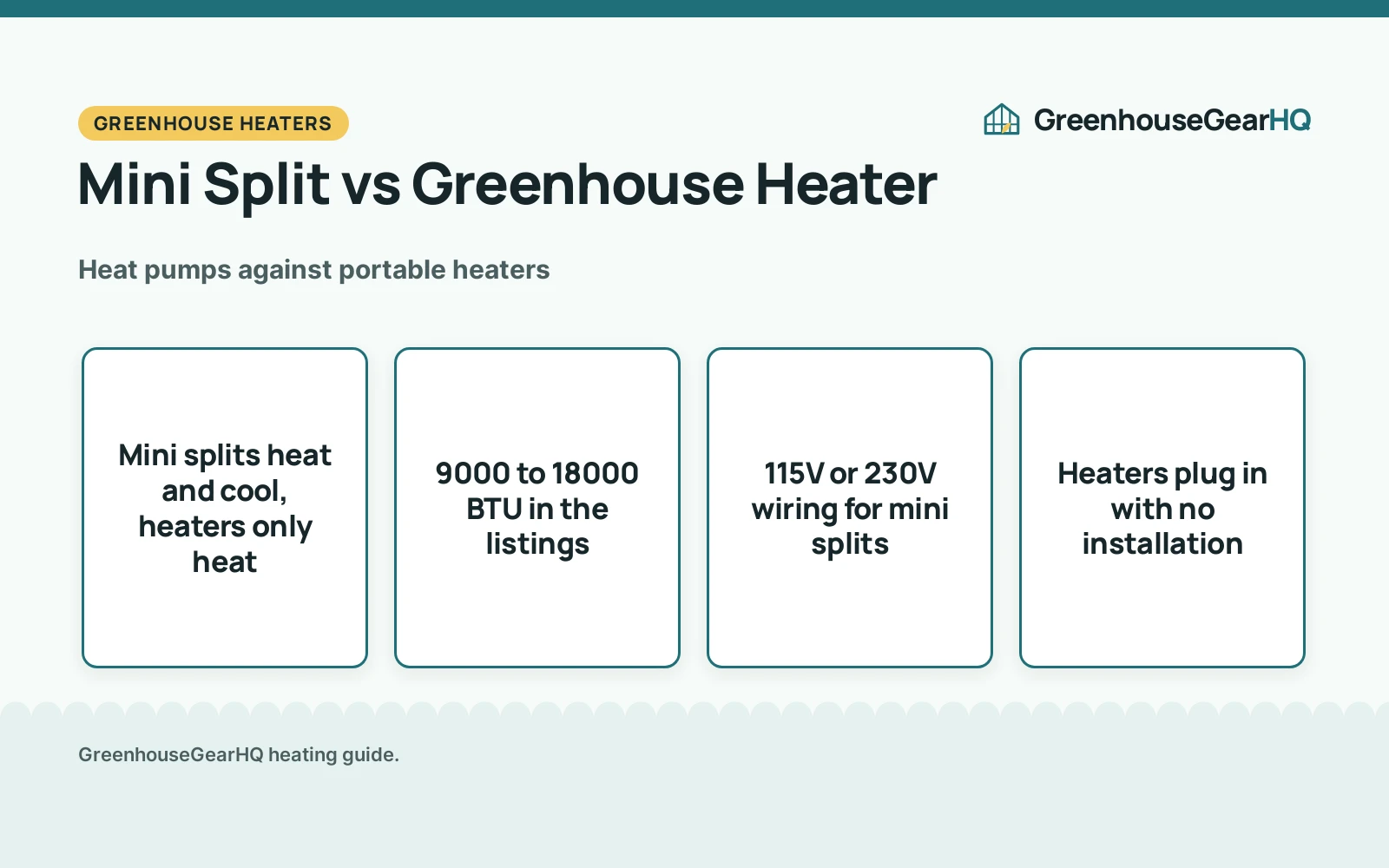
Mini split vs greenhouse heater comes down to installed climate control against portable spot heat: a mini split is a wall-mounted heat pump that both heats and cools and needs professional-style installation with 115V or 230V wiring, while a greenhouse heater is a plug-in electric unit you set on a bench and move as needed. The listings here show mini splits from 9000 to 18000 BTU with SEER2 figures of 17 to 22. Choose a mini split for year-round temperature control in a permanent greenhouse; choose a portable heater for frost protection and spot warming without installation.
Other options worth a look
 Manastin 12000BTU Mini Split AC & Heating SystemCheck price on Amazon
 12000BTU Mini Split Air Conditioner& HeaterCheck price on Amazon
 ROVSUN 11500 BTU Mini Split AC/Heating SystemCheck price on Amazon
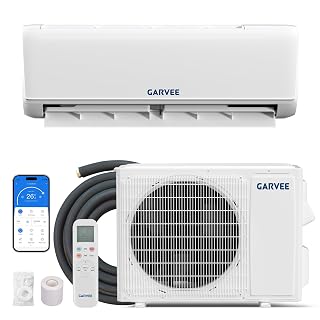 Garvee Mini Split AC with Heat PumpCheck price on Amazon
GreenhouseGearHQ earns a commission when you buy through links on this page, at no extra cost to you. As an Amazon Associate I earn from qualifying purchases. Affiliate disclosure.
What a mini split is
A mini split is a ductless heat pump with an outdoor condenser and an indoor wall unit, moving heat in or out of the space. The listings state models from 9000 BTU, like the ROVSUN at 20 SEER2, through 12000 BTU models such as the Temprium at 22 SEER2 and 115V, up to 18000 BTU models such as the Nexaro at 19 SEER2 and 230V. A mini split heats in winter and cools in summer from the same unit, which a plain heater cannot do.
What a greenhouse heater is
A greenhouse heater is a portable electric heater, usually 1500 watts with a fan, a thermostat and overheat protection, that plugs into a standard outlet and sits where you need it. It heats only, and you move it between benches or take it out for the summer. For frost nights and shoulder seasons in a small greenhouse, that simplicity is the whole appeal: no installation, no refrigerant lines, no electrician.
Heating and cooling in one box
The mini split’s defining advantage is reversibility: the same 12000 BTU unit that warms the greenhouse in March cools it in July. A portable heater only adds heat, so summer cooling needs vents, shade cloth or a separate fan. If your greenhouse overheats in summer as well as freezing in winter, the mini split covers both jobs; if you only fight frost, a heater is enough.
Installation and power
Mini splits need mounting, refrigerant line sets and dedicated wiring: the listings state 115V on the smaller models and 230V on the 18000 BTU units, plus installation kits. That means planning, a level wall and an electrician for the 230V models. A portable greenhouse heater plugs into an existing outlet and runs the same day. For a rented plot or a temporary structure, the plug-in heater wins on practicality alone.
Mini split vs greenhouse heater sizing: BTU and coverage
Match the unit to the space using the listing’s stated coverage. The mini split listings state coverage from 400 square feet on smaller models up to 1250 square feet on larger ones, with 450 and 750 square feet in between. Higher SEER2 numbers, up to 22 on the Temprium listings, state better efficiency for the cooling side. Do not size by BTU alone: a drafty poly tunnel and a tight twin-wall house lose heat at different rates, so treat the listing’s coverage as a starting point for a sealed structure.
What this guide does not cover
This guide covers electric mini splits and portable electric heaters only, not propane or diesel heaters and not wiring or circuit sizing. For fuel-burning options, our diesel vs propane greenhouse heater guide compares them, and our electric vs propane greenhouse heater guide compares fuel types.
FAQ for growers
Can a mini split replace a greenhouse heater?
For heating, yes, and it also cools. A 12000 BTU mini split like the Temprium at 22 SEER2 heats and cools, while a portable heater only heats. The mini split needs installation and 115V or 230V wiring.
What size mini split does a greenhouse need?
The listings state 9000 to 18000 BTU with coverage from 400 to 1250 square feet. Match the stated coverage to your floor space and treat it as a starting point for a sealed structure.
Do mini splits need professional installation?
The listings include installation kits, but the units need wall mounting, refrigerant lines and dedicated 115V or 230V wiring. Plan for an electrician, especially on 230V models.
Which is more efficient?
For cooling, the SEER2 figure states efficiency: the Temprium listings state up to 22 SEER2, the ROVSUN 20, the Nexaro and Manastin 19, and others 17. A portable heater has no SEER2 figure; it converts electricity to heat directly.
Is a portable heater enough for winter?
For frost protection and small greenhouses, often yes. A plug-in heater needs no installation, but it only heats, so summer cooling needs vents or shade.
Keep reading
See every greenhouse heater guide and all light and heat guides.
More picks: best greenhouse heater, infrared vs ceramic greenhouse heater and electric vs propane greenhouse heater.