On this page
Top picks at a glance
As an Amazon Associate I earn from qualifying purchases.
- 1
 APILAB Solar Shed Light with Pull String9.5/10View on Amazon
- 2
 Quictent 20x10x6.6 FT Tunnel Greenhouse with Dual Hinged Doors9.8/10View on Amazon
- 3
 Aqonsie Solar Shed Light9.4/10View on Amazon
- 4
 The Chinese Greenhouse: Design and Build a Low-CostView on Amazon
- 5
 Bayliss XL AutoventView on Amazon
- 6
 A ANLEOLIFE Automatic Greenhouse Vent OpenerView on Amazon
- 7
 18" Solar FanView on Amazon
- 8
 BIBISTORE Automatic Greenhouse Vent Opener with Two SpringsView on Amazon
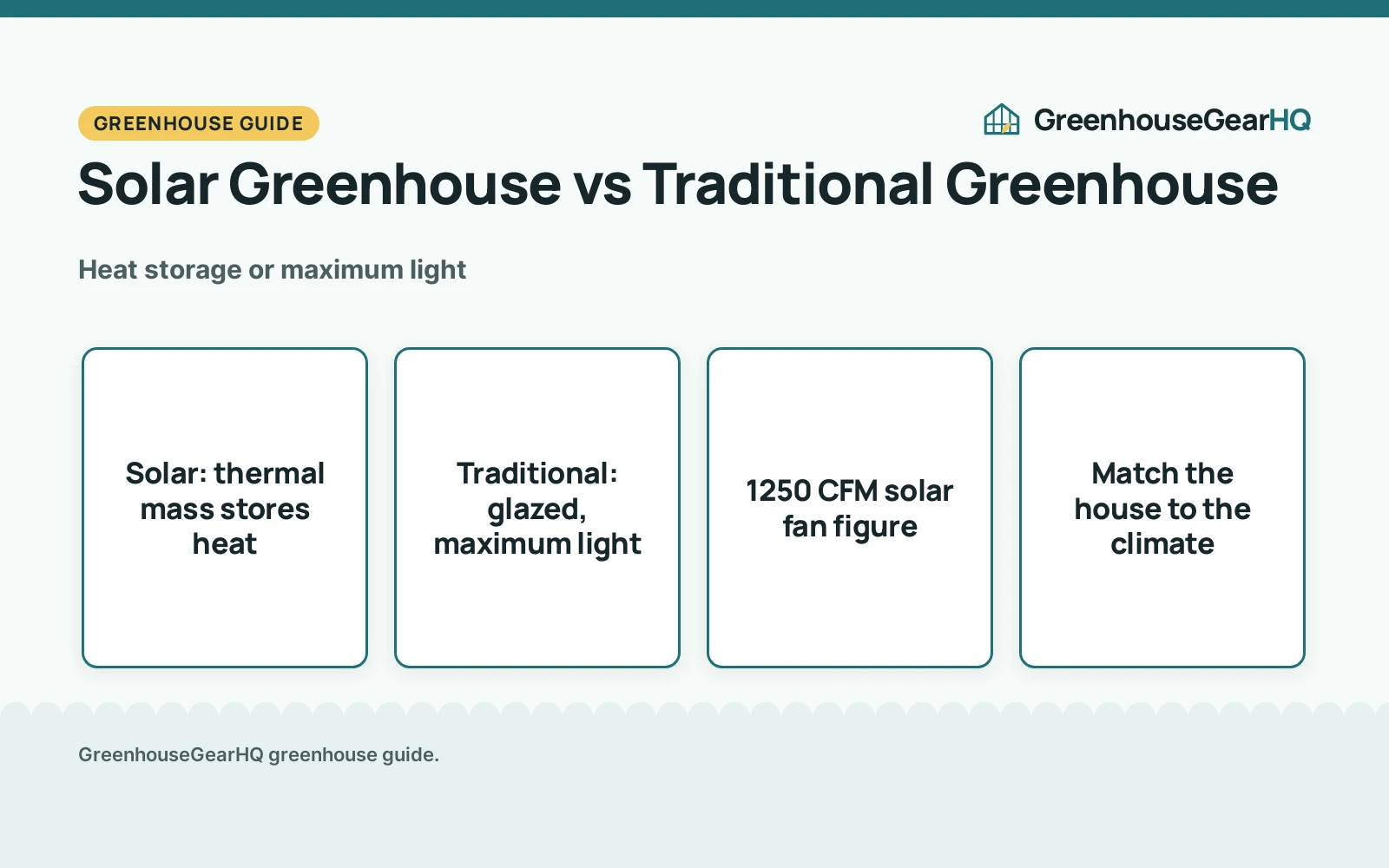
Solar greenhouse vs traditional greenhouse: the short answer is that a solar greenhouse stores daytime heat in thermal mass and insulated walls to stay warm at night, while a traditional greenhouse is a glazed box that heats up in the sun and cools at night. One is designed around heat storage; the other around maximum light. The reference listings include solar-powered greenhouse gear and books on passive solar design, with concrete figures where stated.
Other options worth a look
 The Chinese Greenhouse: Design and Build a Low-CostCheck price on Amazon
 Bayliss XL AutoventCheck price on Amazon
 A ANLEOLIFE Automatic Greenhouse Vent OpenerCheck price on Amazon
 18" Solar FanCheck price on Amazon
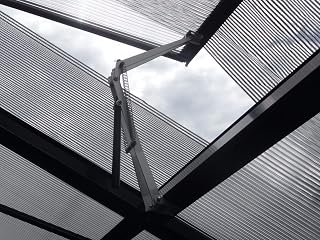 BIBISTORE Automatic Greenhouse Vent Opener with Two SpringsCheck price on Amazon
GreenhouseGearHQ earns a commission when you buy through links on this page, at no extra cost to you. As an Amazon Associate I earn from qualifying purchases. Affiliate disclosure.
Solar greenhouse vs traditional greenhouse: how they differ
The difference is what the structure does with the sun. A traditional greenhouse collects solar heat through its glazing and loses it again at night through the same glass. A solar greenhouse, often called a passive solar greenhouse, collects the same heat but stores it in thermal mass and insulated walls, releasing it after dark. The books in the reference listings describe the approach: The Year-Round Solar Greenhouse covers net-zero energy design, and The Chinese Greenhouse covers low-cost passive solar design.
Solar greenhouse: thermal mass and insulated walls
A solar greenhouse is built like a heat battery. Glazing faces the sun, usually south, while the north wall is insulated and often earth-sheltered, as in The Earth Sheltered Solar Greenhouse Book. Inside, thermal mass such as water barrels, stone or concrete floors soaks up daytime warmth and releases it at night, smoothing the temperature swing. The design costs more in planning and mass but runs on little or no added heat, which suits cold, sunny climates with cold nights.
Choose a solar greenhouse when winter nights are the problem, when you want low running costs, and when the site allows a south-facing, insulated build.
Traditional greenhouse: maximum light, added heat
A traditional greenhouse is glazed on all sides for maximum light, which suits propagation and light-hungry crops. The price of all that glass is heat loss: at night the house cools fast, so growers add heaters in winter and ventilation in summer. Solar-powered gear can cover the ventilation side: the ecoCalm 10-inch solar fan listing states a 5000mAh battery for up to 5 hours of ventilation after a full charge, the ecoCalm dual 5.5-inch fan listing states a 4400mAh battery for up to 8 hours, and the windfox 12-inch solar exhaust fan listing states 1250 CFM with dual 30W solar panels. For light after dark, the APILAB solar shed light listing states 2000LM at 6500K.
Choose a traditional greenhouse when maximum light matters most, when the climate is mild, and when you accept heating and cooling gear as part of the build.
How to decide: climate, cost and complexity
Start with the climate problem. Cold nights with sunny days favor the solar greenhouse: thermal mass and insulation do the night work for free. Mild climates or light-critical crops favor the traditional house, with added heat where needed. Then weigh the build: a solar greenhouse needs more design, mass and insulation; a traditional kit goes up fast and leans on equipment. Finally, plan ventilation either way: the solar fan figures above show what off-grid ventilation looks like, from 1250 CFM exhaust down to 5 to 8 hours of battery circulation.
Which one should you buy?
| Type | Heat strategy | Strengths | Suits |
|---|---|---|---|
| Solar greenhouse | Thermal mass, insulated walls | Warm nights, low running cost | Cold nights, sunny days |
| Traditional greenhouse | Glazing plus added heat | Maximum light, simple build | Mild climates, propagation |
Match the house to the climate. Cold nights lean solar: see our budget greenhouses for kit examples. Light-first growing leans traditional; browse every walk-in greenhouse guide for more.
FAQ for growers
What is a Chinese-style solar greenhouse?
The Chinese Greenhouse book in the reference listings describes a low-cost passive solar design: south glazing, insulated north wall and thermal mass storing daytime heat for the night. It is the classic solar greenhouse form.
Do solar greenhouses need heaters?
Thermal mass covers mild nights, but extreme cold still needs backup heat. A solar greenhouse reduces heating, it does not always remove it.
Can solar fans ventilate a greenhouse?
Yes, for the ventilation side. The windfox 12-inch solar exhaust fan listing states 1250 CFM with dual 30W panels, and the ecoCalm listings state 5000mAh for up to 5 hours and 4400mAh for up to 8 hours of battery-powered circulation.
Which costs more to run?
A solar greenhouse, once built: thermal mass and insulation work for free. A traditional greenhouse costs more to run, since heaters make up the night heat loss and fans handle summer heat.
Keep reading
See every walk-in greenhouse guide and all greenhouse guides.
More picks: budget greenhouses, greenhouse plastic for cold climates, greenhouse fans.