On this page
Top picks at a glance
As an Amazon Associate I earn from qualifying purchases.
- 1
 VEVOR Walk-In Tunnel Greenhouse9.7/10View on Amazon
- 2
 Garvee 8x12 FT Greenhouse with Aluminum Frame9.6/10View on Amazon
- 3
 GreenhouseView on Amazon
- 4
 Walk-in GreenhouseView on Amazon
- 5
 KING BIRD Premium 25x10x6.6FT Greenhouse for OutdoorsView on Amazon
- 6
 KING BIRD Premium 15x6.6x6.6FT Greenhouse for Outdoors LargeView on Amazon
- 7
 KING BIRD Premium 20x10x6.6FT Greenhouse for Outdoors LargeView on Amazon
- 8
 Greenhouse Clips to Secure Plastic PanelsView on Amazon
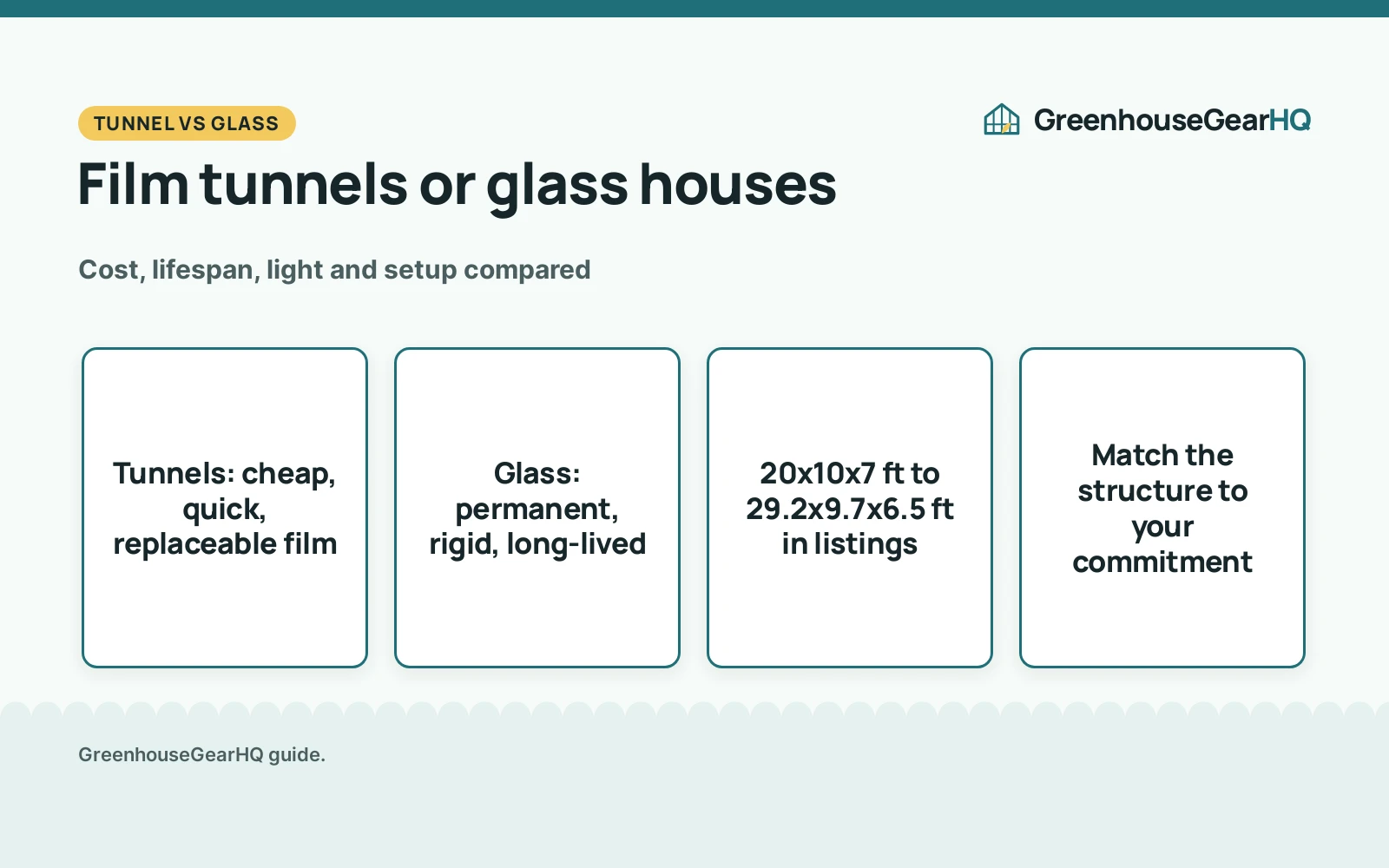
Tunnel greenhouse vs glass greenhouse comes down to cost and permanence: a tunnel greenhouse is a hoop-framed structure with a film cover, cheap and quick to set up, while a glass greenhouse is a rigid framed building that lasts for decades. The listings here are all tunnels, from the Outsunny 20 x 10 x 7 ft walk-ins to the VEVOR 29.2×9.7×6.5 ft hoop house and the compact Sylviera 6×8 FT. Choose a tunnel for affordable season extension; choose glass for a permanent growing space.
Other options worth a look
 GreenhouseCheck price on Amazon
 Walk-in GreenhouseCheck price on Amazon
 KING BIRD Premium 25x10x6.6FT Greenhouse for OutdoorsCheck price on Amazon
 KING BIRD Premium 15x6.6x6.6FT Greenhouse for Outdoors LargeCheck price on Amazon
 KING BIRD Premium 20x10x6.6FT Greenhouse for Outdoors LargeCheck price on Amazon
 Greenhouse Clips to Secure Plastic PanelsCheck price on Amazon
GreenhouseGearHQ earns a commission when you buy through links on this page, at no extra cost to you. As an Amazon Associate I earn from qualifying purchases. Affiliate disclosure.
What a tunnel greenhouse is
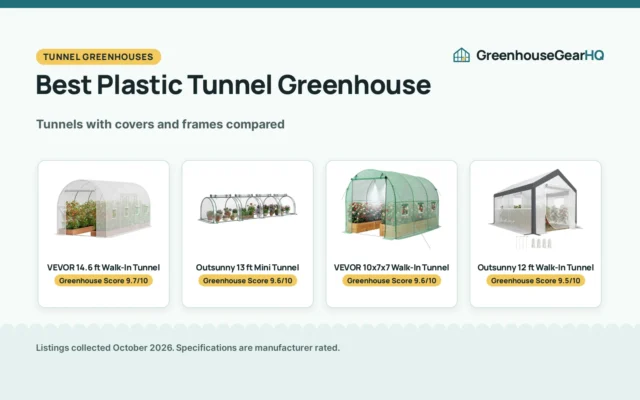
A tunnel greenhouse is a series of hoops covered in polyethylene film, often with zippered doors and roll-up sides. The listings show the range: Outsunny offers 20 x 10 x 7 ft and 12 x 7 x 7 ft walk-in tunnels, VEVOR lists a 29.2×9.7×6.5 ft hoop house, Phonjoroo a 15x7x7 ft walk-in with a spraying system, and Sylviera a 6×8 FT compact house with a hygrometer. Strong Camel even sells a replacement frame for 20 x 10 x 7 ft tunnels, which shows how modular these structures are. Setup is a weekend job, and the film cover is replaceable when it wears out.
What a glass greenhouse is
A glass greenhouse uses rigid glass panels in an aluminum or steel frame, built on a foundation or base as a permanent structure. Glass transmits light well and looks the part in a garden, but it is heavy, expensive and unforgiving: panels break in hail or from a stray ball, and the structure cannot move. No glass listing is in the data here, so treat glass figures from sellers on their own terms. Glass suits gardeners who want a decades-long fixture, not a quick shelter.
Cost and lifespan
Tunnels win on upfront cost by a wide margin: film and hoops are cheap, which is why a 20 x 10 x 7 ft tunnel is an impulse buy where a glass house of the same footprint is a project. The tradeoff is lifespan. Tunnel film degrades in sun and needs replacing every few seasons, while glass lasts as long as the frame does. Over decades, the tunnel’s replacement covers add up, but most buyers never keep a tunnel that long: they outgrow it or upgrade.
Light, heat and ventilation
Both grow plants, but they behave differently. Tunnel film diffuses light, which seedlings like, and the zippered doors and roll-up sides on the Outsunny listings give easy ventilation. Glass gives clearer light and holds heat better in a well-sealed structure, but it overheats fast on sunny days without vents. In wind, tunnels flex where glass resists: the listings mention wind repeatedly, and anchoring is non-negotiable for any tunnel. Snow load is the tunnel’s weak point, with snow mentioned far less than wind in the data.
Tunnel greenhouse vs glass greenhouse: which suits you
Match the structure to your commitment. Renting, experimenting or extending the season on a budget: buy a tunnel, like the 12 x 7 x 7 ft Outsunny for a first house or the 29.2×9.7×6.5 ft VEVOR for serious space. Settled with a forever garden and the budget for a foundation: glass rewards you for decades. Many growers start with a tunnel and buy glass later, and the tunnel then becomes a potting or overflow house.
What this guide does not cover
This guide covers tunnels and glass only. For panel comparisons, see our polycarbonate vs glass greenhouse guide, and for tunnel shapes see high tunnel vs caterpillar tunnel.
FAQ for growers
How long does a tunnel greenhouse last?
The frame lasts years; the film cover needs replacing every few seasons depending on sun exposure. Replacement covers and frames, like the Strong Camel 20 x 10 x 7 ft frame, keep the structure going.
Is glass better for growing than film?
Not necessarily. Film diffuses light well for seedlings, while glass gives clearer light and better heat retention in a sealed house. Ventilation matters more than the cover.
Can a tunnel greenhouse survive winter?
With anchoring and snow clearing, yes for the season-extension role. Heavy snow is the main risk; the listings emphasize wind anchoring far more than snow load.
Which is cheaper to start with?
The tunnel, by a wide margin. A walk-in tunnel like the 20 x 10 x 7 ft Outsunny costs a fraction of a comparable glass house.
Keep reading
See every greenhouse guide and all light and heat guides.
More picks: polycarbonate vs glass greenhouse, high tunnel vs caterpillar tunnel and geodesic dome vs A frame greenhouse.