On this page
When a cold front moves over the garden and the sky turns grey, a grower starts watching the weather and wondering what the air is doing. That is the moment to ask, what is barometer, and what can it tell you about the hours ahead? A barometer is an instrument that measures air pressure, the weight of the air pressing down around you. Read over time, its needle shows whether pressure is rising, falling or holding steady, and that trend is the clue growers use to plan watering, venting and cover for tender plants.
GreenhouseGearHQ earns a commission when you buy through links on this page, at no extra cost to you. As an Amazon Associate I earn from qualifying purchases. Affiliate disclosure.
What is barometer, in plain terms
Air has weight, and a barometer weighs it. The instrument senses how hard the air presses on a surface and shows the result on a dial or a screen. When pressure rises, the air is usually settling and the weather is often clearing. When pressure falls, unsettled air is moving in and rain or wind may follow. The reading on its own says little; the change from morning to evening says much more. A grower who notes the direction of the trend gets a simple heads-up before opening vents or moving tender trays out into the open.
The kinds of barometer you will see
Barometers come in a few shapes, and the shape decides how you read it and where it can live. All of them measure the same thing, air pressure, and all of them reward a reader who watches the trend rather than a lone reading.
Mercury barometers
A mercury barometer is a glass tube with mercury inside, set beside a scale. Air pressure pushes on the mercury and moves the level in the tube, so the height of the column shows the pressure. These instruments are precise and need a fixed spot on a wall, away from knocks, where the tube stays safe and upright.
Aneroid barometers
An aneroid barometer holds a sealed metal cell with the air taken out. Pressure squeezes or frees the cell, and a set of levers moves a needle around a dial. The dial often carries words for fair, changeable and rainy weather beside the marks, so the reading is easy to follow at a glance. Aneroid dials are the round wall instruments seen in many garden rooms, and they need no liquid and no power, which makes them a simple fit for a greenhouse wall.
Digital barometers
A digital barometer uses a sensor to feel pressure and shows the result as figures on a screen. Many digital models also show temperature and humidity beside the pressure, and some keep a record of past readings so the trend is easy to see without a notebook. A digital model suits a grower who wants the trend at a glance without reading a dial. See the barometer temperature humidity gauge guide for a model that shows pressure, temperature and humidity together.
How to read a barometer
Reading a barometer is a habit, not a quick glance. The steps below turn a dial or a screen into a useful daily routine, and they work for every kind of barometer, from a wall dial to a digital display.
Take a reading at a steady hour
Pressure drifts through the day, so a reading means more when it is taken at a steady hour. Pick a time that suits your routine, such as the morning round of the greenhouse, and note the reading in a small book or on a card by the dial. A short note each day builds a picture of normal pressure for your garden, and a sharp move away from that normal stands out at once.
Watch the direction, not the reading alone
A high or low reading on its own tells you little, because normal pressure differs by place and by season. What matters is the move: a steady rise points to settling weather, a steady fall points to unsettled weather, and a fast fall points to a storm on the way. Wait for the needle to move and hold its new place before you act on it, since a brief wobble means less than a trend that lasts through the day.
Compare the dial with the sky outside
Match the dial with what you see. Grey cloud and a falling needle agree, and a clear sky with a rising needle agrees. When the dial and the sky disagree, trust the sky for the next hour and keep watching the dial. A barometer is a guide to the trend, not a promise about the next shower, and the sky above the garden is the other half of the picture.
Reading a barometer in the greenhouse
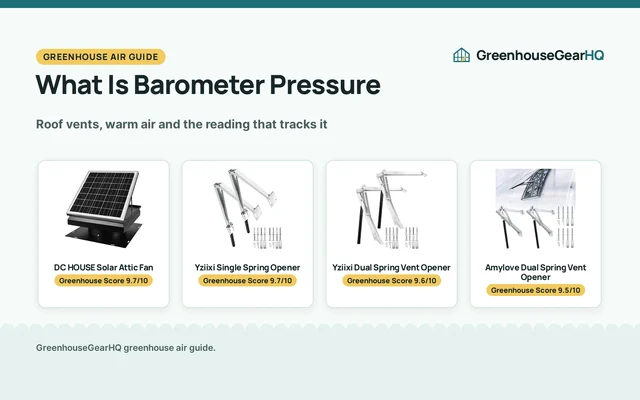
Inside a greenhouse, a barometer earns its place beside the thermometer and the hygrometer. Pressure shifts often arrive before the weather changes outside, so a falling needle is an early hint to close vents ahead of rain or to hold off watering until the sky clears. A rising needle after a wet spell is a hint that the greenhouse can dry out, so vents can open and damp air can leave. The instrument does not change the weather; it gives you time to get ready for it. The what is barometer pressure guide explains how roof vents work with pressure changes.
Where to put a barometer
Hang a barometer where you can see it on your daily round, at eye level on a wall that stays dry and out of direct sun. Keep it away from heaters, doors that slam and draughts from vents, because heat and moving air can nudge the reading. A spot near the greenhouse door works well, as long as the door does not shake the wall when it closes. For a digital model, keep the sensor clear of wet leaves and splashes, and change its batteries when the display fades.
What a barometer does not do
A barometer does not measure heat or dampness. Temperature belongs to a thermometer, and dampness in the air belongs to a hygrometer; a combined gauge shows all of them side by side. See the hygrometer uses guide for how humidity readings help in a greenhouse. A barometer also does not forecast on its own. It shows pressure, and pressure is a sign among many, so use it with the sky, the wind and the forecast from your local weather service.
A weather station gathers pressure, temperature and humidity together in the same place. See the best digital weather station picks if you want every reading together.
FAQ for growers
What does a barometer measure?
A barometer measures air pressure, the weight of the air pressing down around you. The reading shows how the pressure stands now, and the change in the reading shows which way the weather is heading.
Does a falling barometer mean rain is coming?
A falling barometer points to unsettled weather, and rain often follows a steady fall. It is a sign to watch, not a promise, so use it with the sky and the forecast before you change your plans.
Where should I hang a barometer in a greenhouse?
Hang it at eye level on a dry wall out of direct sun, away from heaters and draughty vents, where you pass it on your daily round. A spot near the door works well, as long as the door does not shake the wall.
Do I need a barometer if I already have a thermometer?
A thermometer and a barometer measure different things. A thermometer measures heat, while a barometer measures air pressure, and pressure gives an early hint of weather change that heat alone cannot show. A combined gauge or a weather station covers them together in the same place.
Keep reading
See every greenhouse thermometers guide and all light and heat guides. Also see the best greenhouse thermometer for homestead picks. Also see the best wireless hygrometer picks. Also see the thermometer for soil temperature guide. Also see the best digital weather station picks.
More picks: barometer temperature humidity gauge, what is barometer pressure, hygrometer uses and wireless hygrometer.