On this page
Top picks at a glance
As an Amazon Associate I earn from qualifying purchases.
- 1
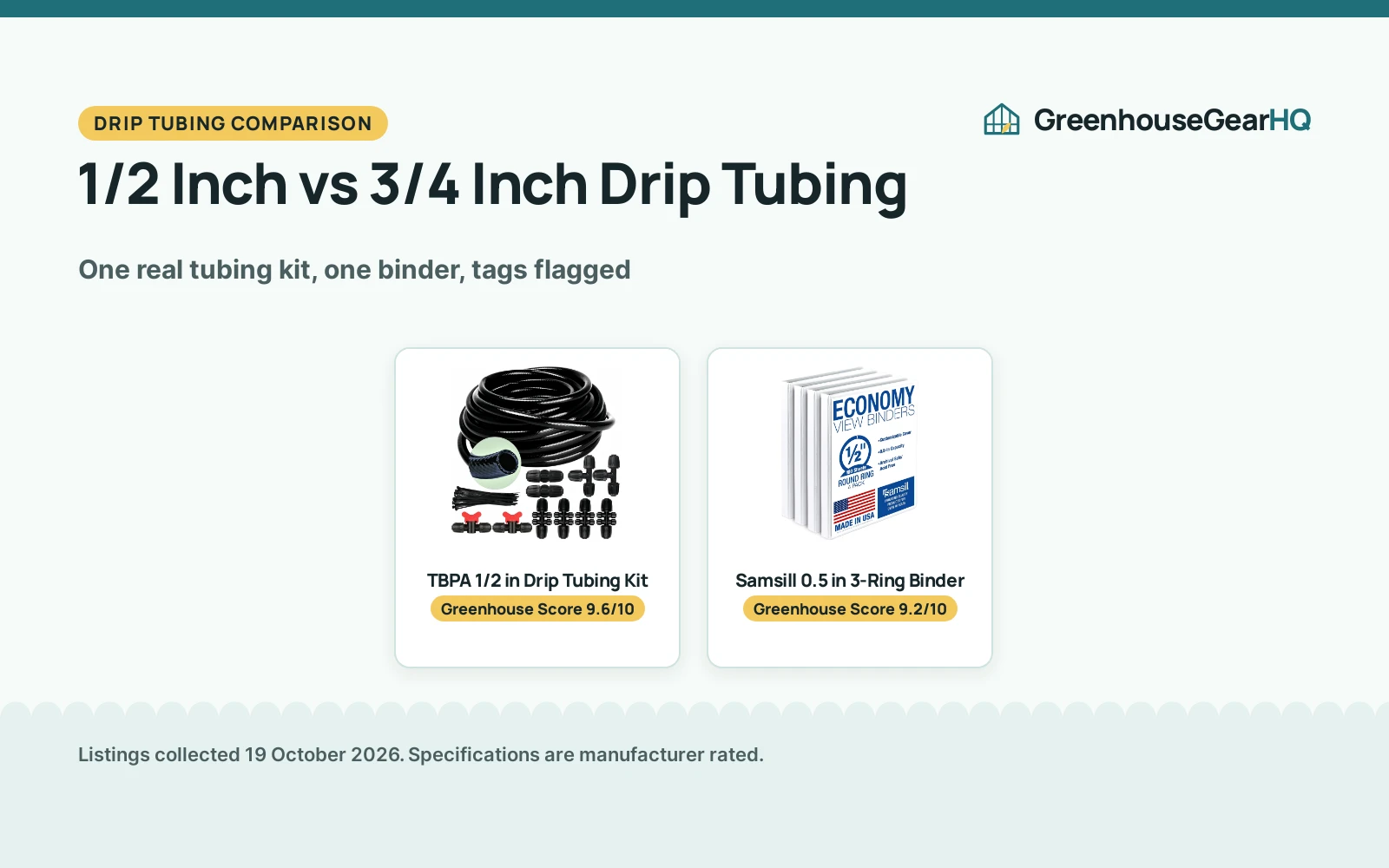
 TBPA 1/2 in Drip Tubing Kit9.6/10View on Amazon
- 2
 Samsill 0.5 in 3-Ring Binder9.2/10View on Amazon
The 1/2 inch vs 3/4 inch drip tubing question is really about which line does which job: the smaller tube feeds branches and emitters, while the larger tube carries the main supply. We compared two listings tagged for the two sides, but read them carefully first: the example tagged for the 1/2 inch side is a 1/2-inch ring binder, not tubing, and the example tagged for the 3/4 inch side describes 1/2-inch tubing in its own title and bullets. This guide compares what the listings actually state, flags where the tags go wrong, and leaves the 3/4-inch side marked unclear.
GreenhouseGearHQ earns a commission when you buy through links on this page, at no extra cost to you. As an Amazon Associate I earn from qualifying purchases. Affiliate disclosure.
Quick verdict: pick the TBPA 1/2-inch tubing kit if you need a feeder or branch line for a low-flow drip system; its listing describes exactly that role, with stated 13mm inner and 16mm outer diameter, 50 feet and a 33 psi maximum. Do not treat the Samsill listing as a tubing example at all: it is a 1/2-inch ring binder. And do not treat the TBPA as a 3/4-inch example either: its title and bullets say 1/2 inch throughout, so neither listing gives a real 3/4-inch tubing figure to compare against.
Two examples

TBPA 1/2 in Drip Tubing Kit
A 50-foot 1/2-inch drip tubing kit with 13mm inner and 16mm outer diameter, 33 psi max, connectors, valves and reducers.
Pros
- Stated 13mm inner diameter, 16mm outer diameter and 3mm wall
- 50 feet with 28 pieces: connectors, valves, T connectors, reducers, zip ties
- 33 psi maximum pressure stated
- UV-resistant layered PVC for above or below ground
Cons
- Tagged as the 3/4 inch side, but the title and bullets say 1/2 inch throughout
- No warranty term is stated
- Reducers included are 1/2 to 1/4 inch only
- No stated flow rate, so size emitters by the 13mm inner diameter

Samsill 0.5 in 3-Ring Binder
A 4-pack of 1/2-inch ring binders with clear-view covers and 2 inside pockets; not drip tubing, despite the side tag.
Pros
- 4-pack of 1/2-inch round-ring binders
- PVC-free polypropylene, archival safe per the listing
- Clear overlay for front, back and spine customization
- 2 clear interior pockets per binder
Cons
- It is a binder, not drip tubing; it cannot illustrate tubing specs
- No warranty term is stated
- Ring capabilities list 1 to 4 inches, but this pack is 1/2 inch only
As an Amazon Associate I earn from qualifying purchases.
Other options worth a look
 Raindrip 052020P 1/2-Inch Drip Irrigation Water Supply TubingCheck price on Amazon
 Raindrip 016005P 1/4-Inch Drip Irrigation Supply TubingCheck price on Amazon
 30PCS Push-to-Fit Drip Irrigation Emitters for 1/4 inchCheck price on Amazon
 50 Pack 6" Inch Angled Drip Emitter StakeCheck price on Amazon
 20 Pcs 1/4 Inch Drip Irrigation Shut Off Valves In-LineCheck price on Amazon
 1/4 Inch Drip Irrigation Shut Off ValvesCheck price on Amazon
1/2 inch vs 3/4 inch drip tubing: side by side
| Drip Tubing | Greenhouse Score | Stated Size | Material | Pressure / Rating | Warranty |
|---|---|---|---|---|---|
| TBPA 1/2 in Drip Tubing Kit | 9.6/10 | 1/2 in, 50 ft | Layered PVC | 33 psi max | Not stated |
| Samsill 0.5 in 3-Ring Binder | 9.2/10 | 0.5 in ring | Polypropylene | Not tubing | Not stated |
Size and build specs are the manufacturer’s ratings as published on each listing, gathered 19 October 2026.
What the 1/2 inch side example actually is
A binder. The Samsill listing tagged for the 1/2 inch side is a 4-pack of 0.5-inch 3-ring binders with clear-view covers, PVC-free polypropylene construction, 2 interior pockets and round rings. Its title and bullets say 100 sheet capacity, while the spec table’s item type name says 125 sheets. Nothing in the listing is tubing, so it contributes no tubing spec to this comparison; it is scored here only because the job includes it.
What the 3/4 inch side example actually is
Half-inch tubing. The TBPA listing tagged for the 3/4 inch side is titled “1/2in. Drip Irrigation Tubing” and its bullets describe a 1/2-inch tube throughout: 13mm inner diameter, 16mm outer diameter, 3mm wall, layered PVC with a sun-resistant outer layer, UV resistance, and use above or below ground. The kit gives 50 feet of tube plus 2 straight connectors, 2 switch valves, 2 T connectors, 4 reducers from 1/2 to 1/4 inch, and 20 cable zip ties, with a stated maximum pressure of 33 psi. Its stated role is a main supply line for low-flow drip systems and a feeder branching off from larger pipes. Since the listing never states a 3/4-inch figure, the 3/4-inch side of this matchup stays unclear.
Listing gaps to check
The Samsill tag does not match its product type: side tag says 1/2 inch, but the product is a ring binder, so treat every tubing cell for it as not applicable. Its sheet capacity naming does not agree between the title and the spec table. The TBPA tag does not match its stated size: side tag says 3/4 inch drip tubing, but the title, bullets and spec table all say 1/2 inch. Neither listing states a warranty term.
Which should you choose?
Choose 1/2 inch tubing if you need a feeder or branch line for a low-flow drip system. The TBPA example describes exactly that role, with stated 13mm inner and 16mm outer diameter, 50 feet of tube and the connectors to branch off to 1/4-inch lines. Compare more kits in our best drip irrigation kit for patio plants picks.
Choose 3/4 inch tubing if your system needs a larger main line upstream of the feeders. These two listings give no 3/4-inch example, so check any listing’s stated inner and outer diameters before buying, and see soaker hose vs drip tape for how other watering lines compare.
If the side tags on a listing do not match its title, trust the title and bullets, as we did here.
In the Greenhouse
- Cut the TBPA tube to length and use the included T connectors to branch 1/4-inch lines to each row.
- Keep runs within the stated 33 psi maximum; the listing describes dual-layer protection against pressure spikes.
- The UV-resistant outer layer suits above-ground runs along the greenhouse bench.
- Measure the actual tube against the stated 13mm inner and 16mm outer diameter before ordering fittings.
Scoring notes
| Product | Greenhouse Score | Perf. /35 | Build /25 | Value /25 | Safety /10 | Warranty /5 |
|---|---|---|---|---|---|---|
| TBPA 1/2 in Drip Tubing Kit | 9.6 | 30 | 21 | 21 | n/a | 0 |
| Samsill 0.5 in 3-Ring Binder | 9.2 | 14 | 19 | 15 | n/a | 0 |
Greenhouse Scores use 9.2 as the lowest value and 9.8 as the highest, with weighted points placed between them in proportion. More points always earns more score. Safety counts for heaters, fans, lights and other powered gear and for listings stating safety features; anything else is scored on 90 points.
The Greenhouse Score weighs performance, build, value, safety and warranty, as explained on our How we pick page. For tubing, safety would mean a stated pressure certification; neither listing states one, so neither earns safety points. The TBPA kit scores on concrete stated specs: diameters, wall thickness, length, pressure rating and 28 included pieces. The Samsill binder scores as a binder, but its performance for a tubing comparison is near zero because it is the wrong item type.
FAQ for growers
Can 1/2 inch tubing work as a main supply line?
The TBPA listing describes its 1/2-inch tube as a main supply line for low-flow drip systems, and also as a feeder branching off from larger pipes. Match the role to your system’s flow.
What are the TBPA kit’s stated dimensions?
13mm inner diameter, 16mm outer diameter, 3mm wall thickness, 50 feet of tube, and a stated maximum pressure of 33 psi.
Is the Samsill listing drip tubing?
No. It is a 4-pack of 1/2-inch 3-ring binders with clear-view covers. It has no tubing specs and suits paper organization, not irrigation.
Does either listing state a warranty?
No. Neither the TBPA nor the Samsill listing states a warranty term.
Keep reading
See every drip irrigation kits guide and all air and water guides. Also see our drip irrigation vs watering wand. Also see our best drip irrigation kit for herbs. Also see our drip emitters vs micro sprayers.
More picks: drip irrigation kit for patio plants, soaker hose vs drip tape and drip irrigation vs misting system.