On this page
Top picks at a glance
As an Amazon Associate I earn from qualifying purchases.
- 1
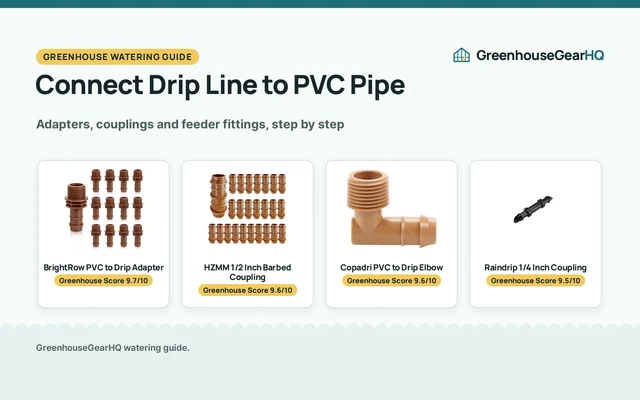
 BrightRow 1/2 Inch PVC to Drip Irrigation Adapter9.7/10View on Amazon
- 2
 HZMM 1/2 Inch Drip Irrigation Barbed Coupling Fittings9.6/10View on Amazon
- 3
 Copadri 1/2 Inch PVC to Drip Irrigation Elbow Adapter9.6/10View on Amazon
- 4
 Chapin 4702 HydroFeed 32-Ounce in-Line Auto-Mix FertilizerView on Amazon
- 5
 Chapin 4701 HydroFeed 24-Ounce in-Line Auto-Mix FertilizerView on Amazon
- 6
 Chapin 4700 HydroFeed 16-Ounce in-Line Auto-Mix FertilizerView on Amazon
- 7
 RAINDRIP INC Mini in-Line Drippers Drip IrrigationView on Amazon
- 8
 1/4 Drip Irrigation Tubing 250FT Brown Drip LineView on Amazon
- 9
 1/4 Drip Irrigation Tubing 100FT Brown Drip LineView on Amazon
A drip line that quits halfway down the bed leaves the far plants dry. How long can a drip line be? It depends on pressure, spacing and flow, not on the roll it comes on. This guide explains what decides the length, how to lay a line that waters evenly to the far end, and what to do when a run is too long. Where a number appears, it comes from a listing cited by name, so it can be checked.
Other options worth a look
 Chapin 4702 HydroFeed 32-Ounce in-Line Auto-Mix FertilizerCheck price on Amazon
 Chapin 4701 HydroFeed 24-Ounce in-Line Auto-Mix FertilizerCheck price on Amazon
 Chapin 4700 HydroFeed 16-Ounce in-Line Auto-Mix FertilizerCheck price on Amazon
 RAINDRIP INC Mini in-Line Drippers Drip IrrigationCheck price on Amazon
 1/4 Drip Irrigation Tubing 250FT Brown Drip LineCheck price on Amazon
 1/4 Drip Irrigation Tubing 100FT Brown Drip LineCheck price on Amazon
GreenhouseGearHQ earns a commission when you buy through links on this page, at no extra cost to you. As an Amazon Associate I earn from qualifying purchases. Affiliate disclosure.
What decides how long a drip line can be
A drip line is a tube with emitters spaced along it, and each emitter drips water at a set rate. The line can be as long as the water still reaches the far end at the same rate as the near end. Pressure drops along a run as water leaves through the emitters, so the far end is where a line shows its limit first. Slope adds to the drop: water runs downhill, so emitters at the low end of a slope get more water than emitters at the high end unless the tubing compensates.
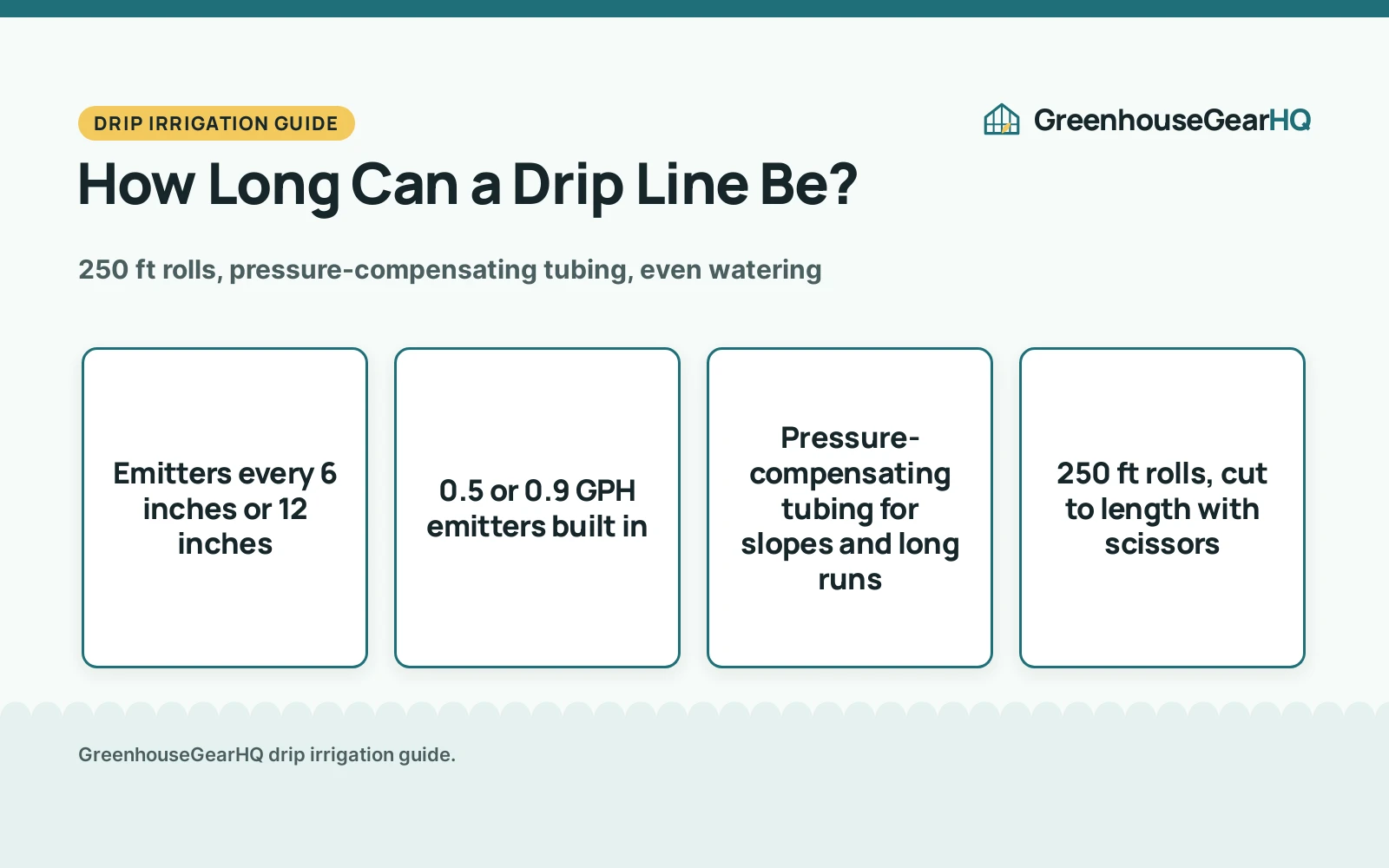
The tubing cited here shows the range on offer. Vikua 1/4 inch tubing has built-in emitters every 6 inches at 0.5 GPH, and Rain Bird XFD dripline (on Amazon) has emitters every 12 inches at 0.9 GPH. Each line cited here comes in a 250 ft roll. Vikua states its tubing can save up to 80% of water use, and its pressure-compensating design holds steady output on uneven ground and long runs, so the plant at the far end gets the same water as the plant at the start.
| Drip line | Tubing | Emitter spacing | Flow per emitter | Roll length |
|---|---|---|---|---|
| Vikua 1/4 inch tubing | 1/4 inch | 6 inches | 0.5 GPH | 250 ft |
| Rain Bird XFD dripline | On-surface dripline | 12 inches | 0.9 GPH | 250 ft |
How long can a drip line be, step by step
Measure the run
Measure the bed or row the line must cover, from the water source to the far end. A roll is 250 ft long, so a run of that length leaves line to spare for bends and the connection at the source. Cut the line to the measured length with scissors, and leave a little extra at the far end to close the line.
Match the tubing to the run
Pick the emitter spacing for the planting. Vikua tubing (on Amazon) has built-in emitters every 6 inches at 0.5 GPH, and Rain Bird XFD has emitters every 12 inches at 0.9 GPH. Closer spacing suits beds of small plants; wider spacing suits rows of larger plants. On a slope, or on a long run, use pressure-compensating tubing: Vikua states its pressure-compensating design holds steady output on uneven ground and long runs. See drip emitters vs drip line for the choice between built-in emitters and separate heads.
Lay the line and check the far end
Lay the line along the row, around bends and past each plant. Vikua states the tubing bends around narrow corners without extra fittings, and cuts with ordinary scissors. Soak the end in hot water for about 10 minutes before fitting, as Vikua states, to soften the tubing. Run the water and watch the far end: if the last emitter drips as steadily as the first, the run is right. If the far end drips less, the run is too long for the pressure at the source.
When a run is too long
Shorten the run, or split the bed into shorter lines fed from the same supply. A shorter line loses less pressure along its length, so the far end keeps up with the near end. Pressure-compensating tubing also helps on long runs and slopes, since it holds the output steady from the start of the line to the end. See gravity vs pressure drip irrigation for how pressure shapes a run.
What this guide does not cover
This guide does not give a maximum length in feet, because the listings cited here state roll lengths and flow rates, not a maximum run. The pressure at the source, the slope of the bed and the number of emitters on the line change how far a line runs evenly, and those figures come from the water supply and the maker, not from this guide. For pressure and flow figures, check the maker manual and the local extension office. This guide does not cover timers, filters or pressure regulators; follow the product label.
FAQ for growers
How long can a 1/4 inch drip line be?
The listings cited here sell 1/4 inch tubing in 250 ft rolls. How far a run waters evenly depends on pressure, slope and emitter spacing; check the far end, and shorten or split the run if it drips less.
What is the difference between 0.5 GPH and 0.9 GPH emitters?
Vikua tubing has 0.5 GPH emitters every 6 inches, and Rain Bird XFD has 0.9 GPH emitters every 12 inches. The 0.9 GPH emitter gives more water per outlet, and the 12 inch spacing puts fewer outlets along the same run.
Do I need pressure-compensating drip tubing?
Vikua states its pressure-compensating tubing holds steady output on uneven ground and long runs. It suits slopes and long beds, where plain tubing would water the low end more than the high end.
How do I fit drip tubing without a hole puncher?
Vikua states its tubing needs no hole puncher or separate drip heads, since the emitters are built in. Soak the end in hot water for about 10 minutes to soften it before fitting, and cut it with ordinary scissors.
Keep reading
See every air and water guide and all drip irrigation kits guides. Also see drip irrigation tubing sizes and pressure compensating vs regular drip emitters.
More picks: best drip line tubing, best pressure regulator for drip irrigation and DIY drip irrigation system.