On this page
Top picks at a glance
As an Amazon Associate I earn from qualifying purchases.
- 1
 Dr Infrared Heater DR-968 Portable Space Heater9.6/10View on Amazon
- 2
 Air Choice Greenhouse Heater with Digital Thermostat9.7/10View on Amazon
- 3
 DR. INFRARED HEATER Portable Infrared Indoor and OutdoorView on Amazon
- 4
 Heat Storm Phoenix Infrared Space Heater with Attachable FeetView on Amazon
- 5
 DR. INFRARED HEATER DR218-3000W Greenhouse Garage WorkshopView on Amazon
- 6
 DR. INFRARED HEATER DR218-1500W Greenhouse Garage WorkshopView on Amazon
- 7
 Infrared Patio Heater 1500W Outdoor Heaters RealSmartView on Amazon
- 8
 Heat Storm HS-1500-PHX-WIFI Infrared HeaterView on Amazon
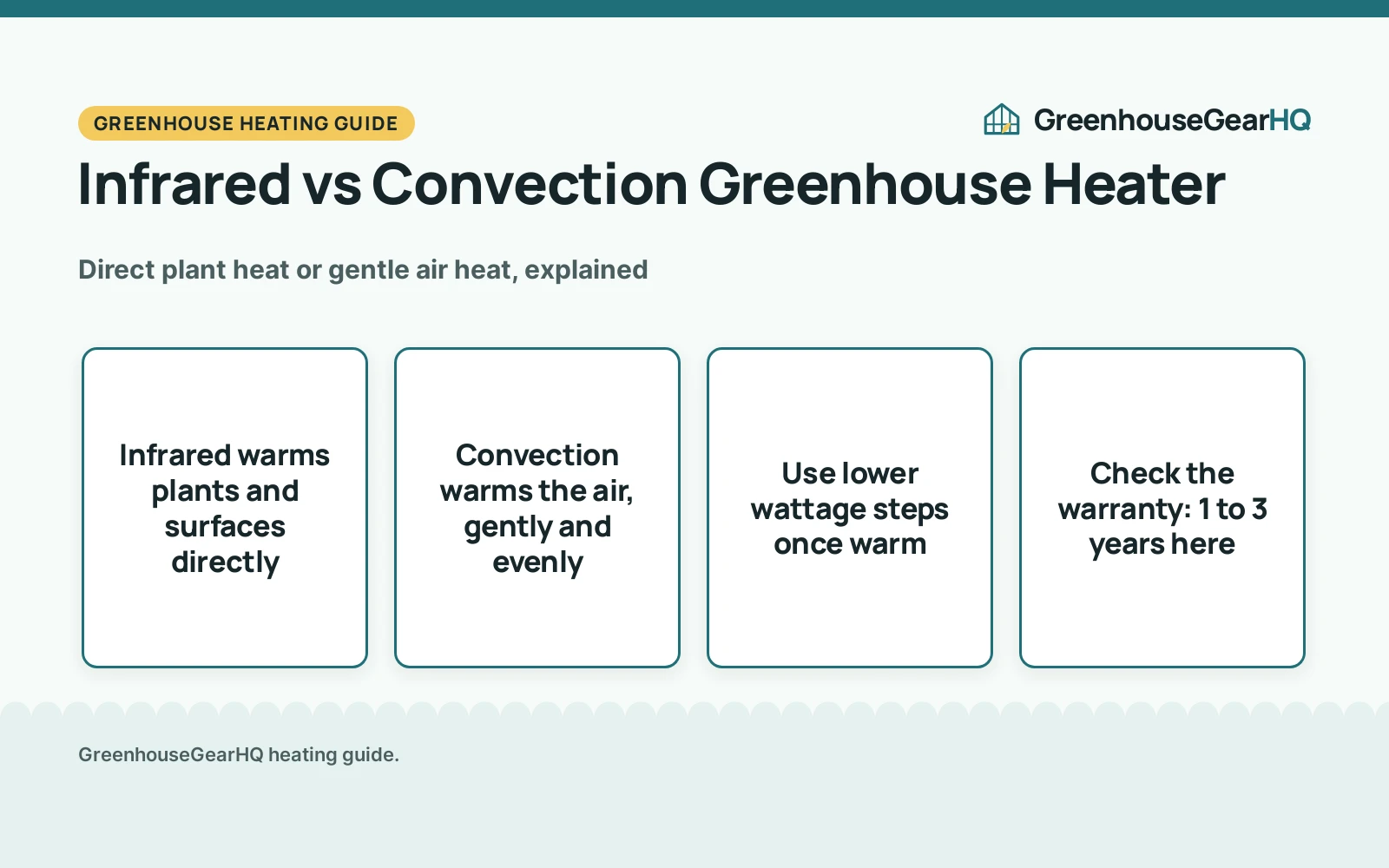
An infrared greenhouse heater radiates heat directly onto plants, benches and soil without warming the air first; a convection heater warms the air, which then drifts around the space on its own. Pick infrared for targeted plant warmth and near-instant heat; pick convection for gentle, whole-space background warmth. This guide explains how each type works, what the listings state, and which suits a given greenhouse.
Other options worth a look
 DR. INFRARED HEATER Portable Infrared Indoor and OutdoorCheck price on Amazon
 Heat Storm Phoenix Infrared Space Heater with Attachable FeetCheck price on Amazon
 DR. INFRARED HEATER DR218-3000W Greenhouse Garage WorkshopCheck price on Amazon
 DR. INFRARED HEATER DR218-1500W Greenhouse Garage WorkshopCheck price on Amazon
 Infrared Patio Heater 1500W Outdoor Heaters RealSmartCheck price on Amazon
 Heat Storm HS-1500-PHX-WIFI Infrared HeaterCheck price on Amazon
GreenhouseGearHQ earns a commission when you buy through links on this site, at no extra cost to you. As an Amazon Associate I earn from qualifying purchases. Affiliate disclosure.
Infrared vs convection greenhouse heater: how they work
An infrared heater’s hot surface emits infrared energy that travels in straight lines and warms whatever it strikes, leaves, pots, soil, people, while the surrounding air stays close to its original temperature. The Dr Infrared Heater listings describe 1500-watt portable infrared units, and the Heat Storm Phoenix listing describes a 1500-watt infrared space heater with 5200 BTU of heat output. A convection heater works the other way: its element warms nearby air, the warm air rises, and cooler air flows in to take its place, creating a slow natural loop with no fan. The BioGreen PALMA listing pairs its 1500-watt element with a fan, but pure convection needs no moving parts at all.
Heat output and coverage
Infrared listings here cluster around 1500 watts: the Dr Infrared DR-968 lists 1500 watts with 5200 BTU, the Heat Storm Phoenix lists 1500 watts with 5200 BTU of heat output, and the Haimmy tower lists 1500 watts of instant heating. Larger infrared exists too: the Dr Infrared DR218-3000W lists 3000W for 600 square feet. The AC Infinity THERMOFORGE S7 takes the opposite approach at 1000W, a precision plant heater aimed at the bench rather than the building. Convection coverage in these listings is modest: the BioGreen PALMA covers 120 square feet at 1500 watts, and a generic greenhouse heater listing covers 120 sq. ft. at 1500W. Infrared heats what it faces regardless of room size; convection must fill the whole volume, so its coverage figure matters more.
Warm-up, placement and drafts
Infrared feels warm within seconds of switching on because the energy lands directly on surfaces; there is no air to preheat. Aim it at the seedling bench or the work area and that zone warms while the walkway stays cool. Convection is slower, the air loop takes time to establish, but the warmth eventually reaches everywhere, including under benches where infrared cannot see. Infrared creates no drafts and dries nothing, since nothing moves; convection’s gentle circulation can dry leaves over time. For frost protection of specific plants, infrared placement wins; for keeping a whole small house above freezing, convection’s even fill wins.
Power settings and warranties
Several infrared listings offer stepped power: the Dr Infrared portable lists 900, 1200 and 1500W, and the Haimmy lists 620W to 1500W, so the heater can idle on low once the zone is warm. The Heat Storm Phoenix lists a 750-watt low setting. Weights run 8 pounds on the portable Dr Infrared and 19 lbs on the DR-968, so placement is flexible. Warranty terms vary: the DR-968 lists a 3 years warranty, the portable Dr Infrared and the DR218-3000W list 1-year limited terms. Check any listing for its warranty before buying, since terms here range from 1 to 3 years.
Which should you choose?
Choose infrared when the job is warming plants rather than air: germination benches, a favorite citrus tree, the potting workstation. The 1000W THERMOFORGE S7 shows how targeted this type gets. Choose convection when a small, well-sealed house needs gentle background heat with no hot spots and no fan noise. Many growers use both: an infrared unit aimed at the benches for the plants, plus a convection or fan heater on a thermostat holding the house minimum. Either way, match the listing’s wattage and coverage to the job, and use the lower power settings once the zone is warm.
FAQ for growers
Does infrared heat the air in a greenhouse?
Very little. Infrared energy warms surfaces directly; the air warms only as a side effect. Convection is the type that heats air.
How much power do infrared heaters use?
Listings here list 1500 watts most often, with 900, 1200 and 1500W steps on some models and a 3000W unit for 600 square feet.
Can I leave an infrared heater on overnight?
Only a model with a thermostat and the safety features its listing states. Check for tip-over and overheat protection before unattended use.
Which is better for seedlings?
Infrared aimed at the bench warms soil and trays directly without drafts. Convection warms the whole house more slowly.
Keep reading
See every greenhouse heaters guide and all greenhouse climate guides.
More picks: best greenhouse heater and geothermal vs propane greenhouse heater.