On this page
Top picks at a glance
As an Amazon Associate I earn from qualifying purchases.
- 1
 HOWE 14x9.5x9 FT Polycarbonate Greenhouse for Outdoors9.7/10View on Amazon
- 2
 YITAHOME 6X12FT Polycarbonate Greenhouse9.7/10View on Amazon
- 3
 YITAHOME 12x6FT Polycarbonate Greenhouse9.7/10View on Amazon
Polycarbonate greenhouse pros and cons come down to one tradeoff: you gain toughness and insulation but give up the crystal-clear view of glass. On a frosty March morning with the first seed trays waiting, a polycarbonate house warms up fast, holds the heat through the night and shrugs off the hailstorm that would crack glass. This guide lays out the pros and cons using figures from current greenhouse listings, so you can decide whether polycarbonate suits your garden.
GreenhouseGearHQ earns a commission when you buy through links on this page, at no extra cost to you. As an Amazon Associate I earn from qualifying purchases. Affiliate disclosure.
Polycarbonate Greenhouse Pros and Cons at a Glance
Polycarbonate is the glazing in most ready-made greenhouse kits: Sylviera lists 4mm, 580g double-wall panels on its 10×12 house, GDFStudio lists 4mm panels on its 6×8, and Jocoevol lists double-layer panels on its 6×8. Makers choose it for the same reasons growers do: it diffuses light, blocks UV, resists impacts and insulates better than a single pane. The tradeoffs are a softer view, a real need for anchoring and assembly that takes a weekend.
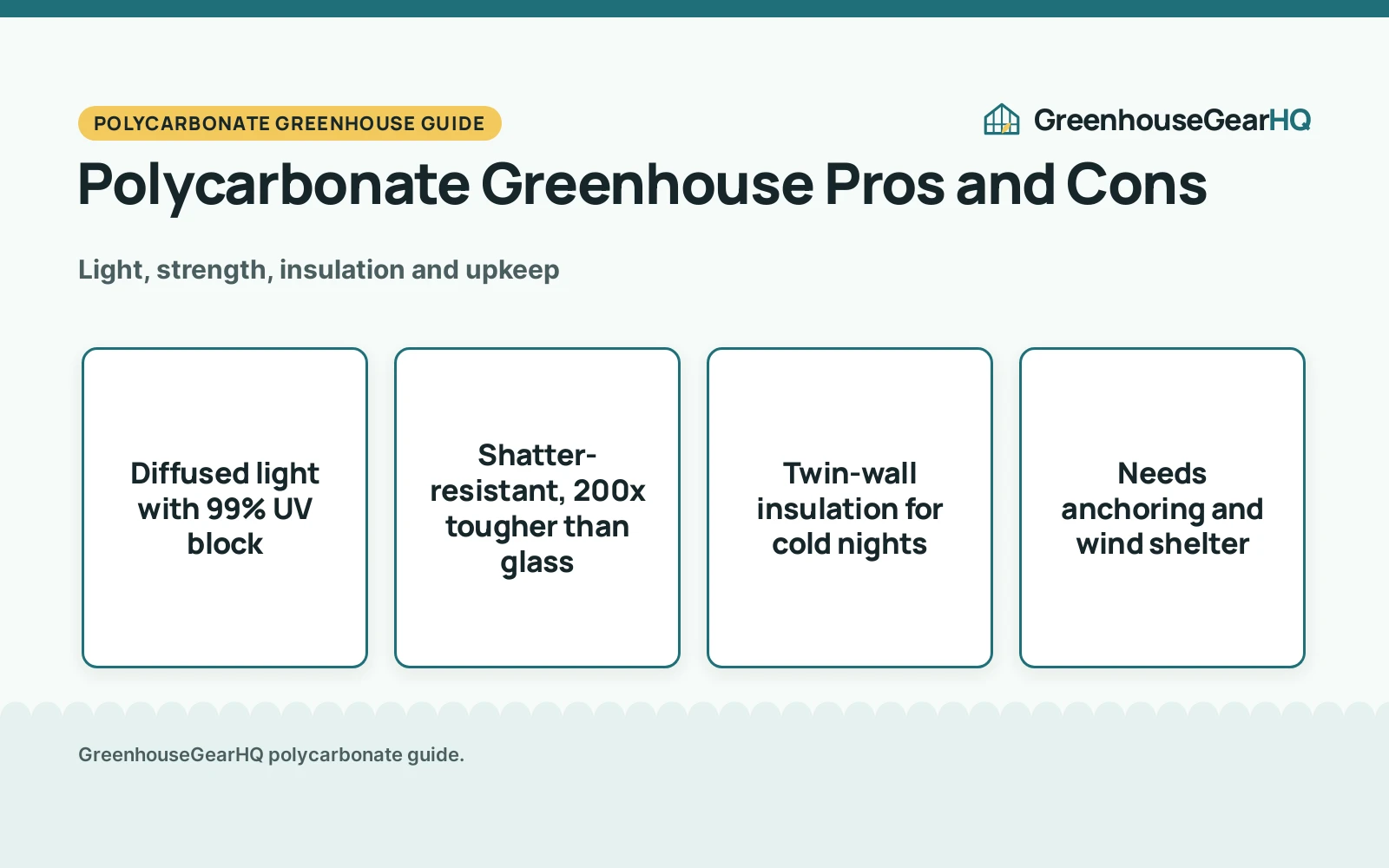
- Pro: diffused light with UV block. Listings state over 90% light transmittance with 99% of UV blocked, or up to 70% transmission with over 99.9% of UV blocked.
- Pro: impact strength. One panel maker claims impact resistance 200 times that of glass; others call their panels shatter-resistant.
- Pro: insulation. Twin-wall and double-wall panels trap air; replacement sheets list service ranges from minus 40 degrees C to 120 degrees C.
- Con: not crystal clear. Milky white panels diffuse light and are, as one maker notes, not fully transparent or clear.
- Con: needs anchoring and shelter. Makers call for ground stakes or anchors and advise against fully exposed, windy sites.
- Con: assembly takes work. Kits ship in two boxes that may arrive separately, and two installers are recommended.
The pros: why growers choose polycarbonate
Light plants can use, UV they cannot
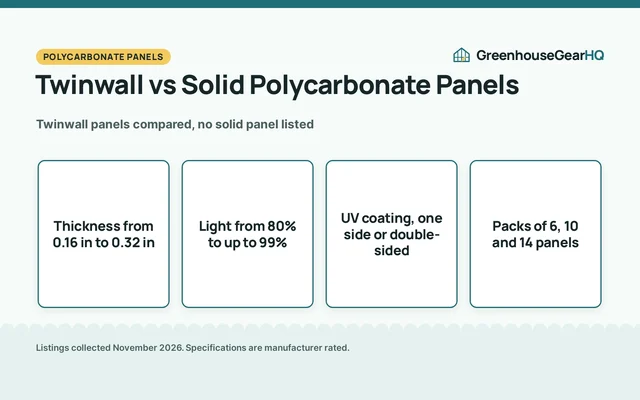
Polycarbonate makers publish both sides of the light story. EVERECO lists over 90% light transmittance with a UV coating that blocks 99% of UV rays, while GDFStudio lists up to 70% light transmission with panels that block over 99.9% of harmful UV. HOOYEAH lists semi-translucent, milky white panels that diffuse sunlight evenly for vegetables, herbs and flowers. Diffused light reaches the lower leaves instead of casting hard shadows, which helps on bright July afternoons when direct sun can scorch tender starts, and the UV block protects both plants and the panels themselves.
Strength that survives the weather
This is the headline advantage. EVERECO states its sheets have an impact resistance 200 times that of glass, and JULY’S SONG calls its panels UV-stabilized and shatter-resistant against hailstorms and heavy winds. Benass describes its twin-wall panels as lighter and safer than traditional glass. For rated strength, Reljofum lists a 50 mph wind rating and a 40 KGS/SQM snow load capacity on its 8×16 house, while Garvee lists over 110 lbs per sq ft of snow load on its 6×8 with 4 ground anchor kits included. Hail, falling branches and a runaway wheelbarrow are the everyday hazards these figures answer.
Insulation for the cold months
Twin-wall and double-wall panels hold a layer of air between their walls. Sylviera lists 4mm thick, 580g double-wall panels that help maintain a stable interior temperature, and Jocoevol lists double-layer panels on a wood-frame 6×8. EVERECO lists a service range of minus 40 degrees C to 120 degrees C for its replacement sheets, and GDFStudio lists minus 20 degrees C to 70 degrees C for its 4mm panels. That air gap is why polycarbonate is the usual pick for late-winter seed starting and for growers who keep the house running through frost nights with a heater.
Light to handle, easy to repair
Polycarbonate keeps the structure light: the Reljofum 8×16 lists 52.7 pounds and the Garvee 6×10 lists 89.6 pounds, both with aluminum frames. When a panel does get damaged, replacements are simple: EVERECO lists 6-foot by 2-foot by 0.24-inch sheets that cut to size with a utility knife, and JULY’S SONG notes its modular design allows effortless panel replacement. EVERECO states its coating resists yellowing and aging, which answers the most common worry about plastic glazing. Our polycarbonate vs acrylic guide compares two rigid glazings head to head.
The cons: what to watch for
Not a crystal-clear view
Diffusion is a feature for plants but a compromise for people. HOOYEAH states plainly that its milky white panels are not fully transparent or clear, creating a soft-light environment. If you want to admire the garden from the patio or keep an eye on ripening tomatoes from the kitchen window, polycarbonate will always look hazier than glass. Growers who prize visibility should weigh this before they buy.
Wind exposure and anchoring are on you
A polycarbonate house is only as steady as its anchors. Benass states its greenhouse must be secured with ground stakes or compatible anchors to a solid base. HOOYEAH advises using its 6×4 in areas with partial wind protection, near fences, walls, shrubs or other natural windbreaks, and avoiding fully exposed locations with strong winds. Budget the stakes, the base work and a sheltered corner of the yard into the project, not just the kit.
Assembly and upkeep take a weekend
Kit assembly is straightforward but not instant. Reljofum and Garvee both note their greenhouses ship in two boxes that may not arrive together, so the build can wait on the second box. Jocoevol suggests 2 installers for the job. YITAHOME-style kits recommend sealing panel edges and fixing the base frame for stability. None of this is difficult, but it is a weekend project rather than an afternoon one, and replacement panels or spare parts are worth ordering with the kit.
What this guide does not cover
We do not quote prices or give a lifespan in years, because the listings compared here publish neither. Frame choice matters as much as glazing: our wood vs aluminum guide and our aluminum vs galvanized steel guide compare the frames these panels sit in. For the ventilation every polycarbonate house needs, see our greenhouse fan for summer heat picks.
FAQ for growers
Is a polycarbonate greenhouse any good?
For most backyard growers, yes. Listings state diffused light with 99% of UV blocked, impact resistance far above glass and twin-wall insulation, with the tradeoffs of a hazier view and a need for solid anchoring.
Does a polycarbonate greenhouse block UV?
The listings state UV protection across brands: EVERECO and Jocoevol list 99% of UV blocked, and GDFStudio lists over 99.9% blocked on its 4mm panels.
How do polycarbonate greenhouses work?
The twin-wall or double-wall panels trap a layer of air that slows heat loss, while adjustable roof vents release excess heat and humidity on sunny days. The UV coating filters harmful rays while the panel diffuses the rest for even plant growth.
How long do polycarbonate greenhouses last?
No lifespan figure is stated in the listings compared here. EVERECO states its UV coating resists yellowing and aging, and several makers describe reinforced aluminum frames for year-round use; treat both as maker claims and check the warranty line before buying.
Keep reading
See every Polycarbonate Greenhouses guide and all Greenhouses guides. Also see our polycarbonate vs polyethylene comparison. Also see our hoop house vs greenhouse guide.
More picks: walk-in greenhouses, cold frame vs mini greenhouse and greenhouses on a budget.