On this page
Top picks at a glance
As an Amazon Associate I earn from qualifying purchases.
- 1
 Hyuduo 30W Solar Panel Heater with USB and DC Ports9.6/10View on Amazon
- 2
 Mr. Heater 99.7/10View on Amazon
- 3
 49ft Solar Drip Irrigation System with USB Charging for 15View on Amazon
- 4
 18" Solar FanView on Amazon
- 5
 Solar Exhaust Fan with 25W Solar PanelView on Amazon
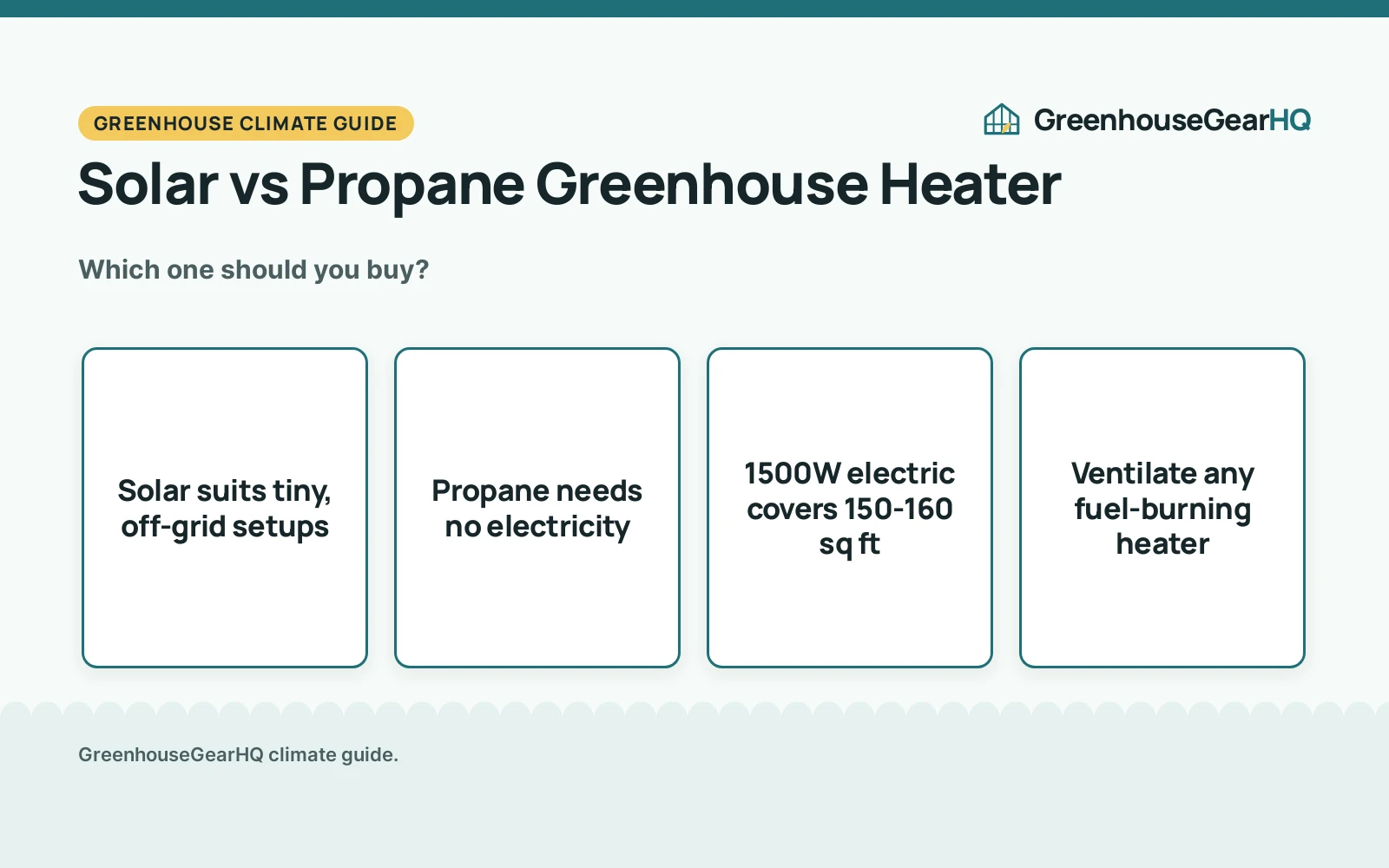
The solar vs propane greenhouse heater question comes down to one thing: what does your greenhouse already have? If it has no electricity, propane is the practical answer. If it has power, electric heat is simpler: 1500W heaters like the Noarixa and lesotc cover 150 to 160 sq ft. Solar heating kits, like the 30W GOWENIC panel heater, are too small for real frost protection and suit only the tiniest setups. This guide walks through how each option heats, what it costs to run, how to size it and where the safety lines are. Where a number appears, it comes from a heater listing we compared.
Other options worth a look
 49ft Solar Drip Irrigation System with USB Charging for 15Check price on Amazon
 18" Solar FanCheck price on Amazon
 Solar Exhaust Fan with 25W Solar PanelCheck price on Amazon
GreenhouseGearHQ earns a commission when you buy through links on this page, at no extra cost to you. As an Amazon Associate I earn from qualifying purchases. Affiliate disclosure.
Solar vs propane greenhouse heater: which should you buy?
Short version first. Buy a propane heater if the greenhouse has no electrical supply and you need serious heat on cold nights. Buy electric if you have an outlet: it is the simplest option, with thermostats doing the work for you. Consider solar only for a small, mild-climate structure where the goal is taking the edge off, not surviving a hard freeze.
| Solar heat kit | Propane heater | Electric heater | |
|---|---|---|---|
| Needs electricity | No | No | Yes |
| Typical output (listings) | 30W panel (GOWENIC) | Not stated in listings | 1500W, 5120 BTU (Noarixa) |
| Coverage (listings) | Tiny spaces | Not stated in listings | 150 to 160 sq ft |
| Fuel logistics | None | Refill or swap tanks | None |
| Ventilation needed | No | Yes | No |
How solar greenhouse heat works
Solar heat for greenhouses comes in two forms. The first is a solar-powered device: a panel feeds a small heater or fan, sometimes through a battery box. The GOWENIC kit, for example, pairs a 30W monocrystalline solar panel with a heater fan and a battery box, so it can run without an external power source. The second form is passive: the greenhouse itself, plus water barrels or stone, soaks up daytime sun and releases it at night.
The catch is output. A 30W panel kit is a drying and spot-warming tool, not a frost fighter. For comparison, the electric greenhouse heaters in the listings run at 1500W, fifty times that wattage, and even those are sized for 150 to 160 sq ft. Solar makes sense where the climate is mild and the structure is small: a lean-to, a cold frame, a tiny polycarbonate house. It also makes sense as a supplement, running ventilation fans by day so heat does not build up.
Battery boxes change the math a little
A battery box lets a solar kit store daytime energy for use after dark. The GOWENIC kit includes one, and solar fan kits like the ecoCalm pair panels with a 6600mAh battery for up to 10 hours of runtime after charging. Storage helps, but it does not multiply the panel’s wattage: a 30W panel still delivers 30W worth of heat. Size the panel to the space, and be honest about winter sun hours in your area.
How propane greenhouse heat works
A propane heater burns bottled gas to produce heat, with no electrical supply needed. That independence is the whole point: a greenhouse at the bottom of the garden, far from any outlet, can still stay above freezing. Propane heaters come as radiant models that warm objects and people directly, and as forced-air models that blow warm air around the space.
The trade-offs are fuel and air. You must keep fuel on hand and swap or refill tanks on a schedule, and every fuel-burning heater needs ventilation: combustion consumes oxygen and produces carbon monoxide and moisture. Never run a propane heater in a sealed greenhouse. A thermostat or thermostatic plug helps, switching the heater on and off with temperature, but the fuel logistics never go away.
How much heat does a greenhouse need?
Size the heater to the floor area. The Noarixa electric heater outputs 5120 BTU from 1500W and covers around 160 sq ft; the lesotc 1500W heater covers 150 sq ft. That gives a rough rule of thumb for electric heat: one 1500W unit per 150 to 160 sq ft of greenhouse. Smaller spaces need less: the TIMEBAL 200W radiant panel is aimed at chicken coops, and a small cold frame may need no heater at all.
Thermostats matter as much as wattage. The Noarixa adjusts between 5 and 42 degrees C (41 to 108 F); the lesotc adjusts between 41 and 113 F; the VEVOR models span 5 to 42 C or 40 to 108 F depending on the model. A thermostat switches the heater on and off to hold the chosen range, which cuts wasted electricity and keeps night temperatures steady for seedlings and young plants.
Match the heater to the coldest night, not the average one
Greenhouses lose heat fast after sunset. Buy for the coldest night you expect, not the seasonal average. An undersized heater running constantly costs more to run than a correctly sized one cycling on a thermostat, and it still may not save the plants.
Running costs and upkeep
Electric heaters are the easiest to budget: the VEVOR and lesotc models draw 12.5A at 120V, and the thermostat limits runtime. Solar kits cost nothing to run once installed, but their output is small. Propane sits in the middle on running cost and highest on upkeep: tanks to refill, burners to check, and ventilation to maintain. Over a winter, the cheapest option is the one you actually maintain: a neglected propane heater with a clogged burner is worse than a slightly undersized electric one on a thermostat.
Safety: the non-negotiables
Fuel-burning heaters need fresh air, full stop. Ventilate any propane heater and never sleep in an enclosed space with one running. Electric heaters have their own rules: the Noarixa, lesotc and VEVOR listings all carry an IPX4 rating for damp greenhouse environments, plus overheat protection, and the lesotc adds tip-over shutoff. The TIMEBAL panel is UL certified. Keep heaters clear of plastic film, shade cloth and dry leaves, and plug electric models directly into a suitable outlet rather than a long extension lead.
FAQ for growers
Can solar panels heat a greenhouse in winter?
Barely. A 30W solar panel kit like the GOWENIC suits tiny spaces and mild climates; for comparison, electric greenhouse heaters run at 1500W and cover 150 to 160 sq ft. Solar works as a supplement, not as the main winter heat source for most greenhouses.
Do propane greenhouse heaters need ventilation?
Yes. Every fuel-burning heater needs fresh air: combustion consumes oxygen and produces carbon monoxide and moisture. Never run one in a sealed greenhouse.
What size electric heater do I need for a small greenhouse?
For 150 to 160 sq ft, a 1500W heater like the Noarixa or lesotc, on a thermostat. For a coop-sized space, a 200W radiant panel like the TIMEBAL is the listing-sized option.
Keep reading
Also see our butane vs propane greenhouse heater. Also see our kerosene vs propane greenhouse heater. Also see our greenhouse heater vs space heater.
More picks: heat pump vs propane greenhouse heater, infrared vs oil filled greenhouse heater and ceramic vs fan forced greenhouse heater.